

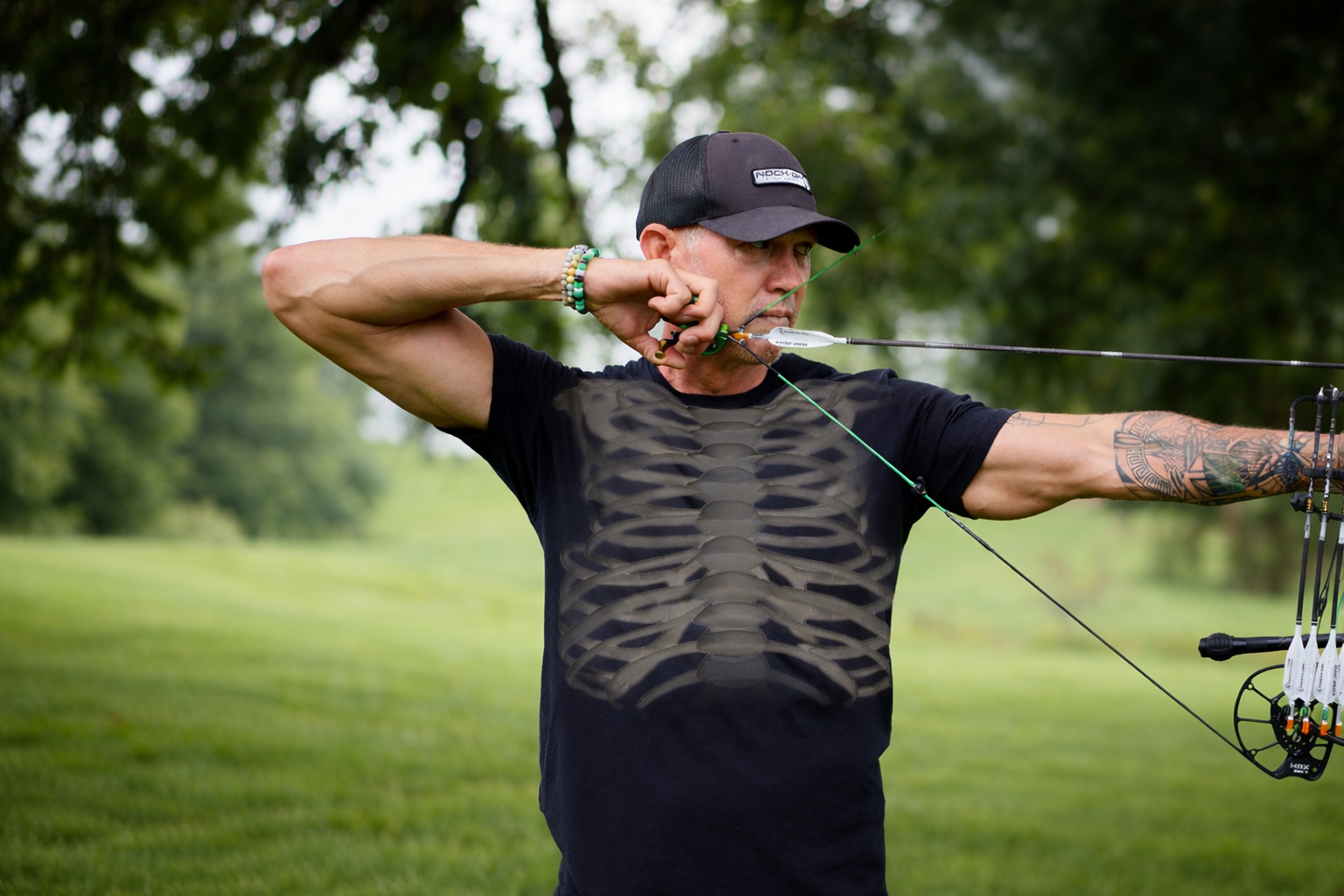
Every tension release shooter has hit the same wall: you’re at full draw, pulling and pulling, and the release won’t fire. You feel like you’re pulling three times harder than the setting. On the flip side, If I had a trigger release then it’s easy to force the shot to happen. That’s the little evil voice in your head that says “just push the button and end the struggle.” It’s easy to do, and then the struggle at full draw is over. However, the arrows just don’t land where you want them too with forced shots and on top of that the little evil voice wins.
With a tension release you can’s hit the button and tap out. Instead you have to pull and pull until you get the surprise. But when its not happening that easy its an uncovering of truth!
I ran into this recently during a practice session. Two nines and a 10 in one end of practice. If I was at an event as a pro i could pack up my bow case after those three arrows and leave because im already way off the podium. Days like this are NOT AWESOME. Looking at the video- I double clutched my draw, was light on my wall, shoulder was constantly creeping although it felt like I was pulling the release in half yet nothing was happening. Shots weren’t easy or fluid. Everything was feeling forced and taking longer to happen than it should. The same struggle had been happening for days before as well. So i found myself in a downward pattern.

It is easy to point the finger at my release, especially a tension release that only fires once you have let off the safety and pulled consistently against the back wall of the cam waiting for the surprise shot. Some days it’s bliss and some days it’s not. On these days it wasn’t working for me i could have easily assumed the release wasn’t firing consistent. Luckily I have a tool for that at work that confirms if its operator error.
I brought our pull-testing machine over to the range and checked the release multiple times. It was firing at the same pull weight time after time after time. The machine told me all I needed to know: the problem wasn’t the release. It was me.
This brings me to some important points for you to read because all of this is relative to what the Silverback Release was telling me!
Bad Shots Take More Effort Than Good Ones
The hardest shots are the bad ones. You put more effort into a bad shot than you ever will into a good one.
Good shots are the ones where you draw back and anchor in, come off your safety, and boom, the shot’s gone. You look downrange, and the arrow’s right in the middle. Good shots go off that easily.
Bad shots happen when you start breaking down in your technique or get tired with your pull. You’re not coming through your shot the right way. All that extra effort goes toward breaking down, not pulling apart.
Compound Bows Want Continual Dynamic Force
Compound bows respond to continual dynamic force pulling through the shot. For perfect arrows that hit the same hole I need to draw back, check in against my back wall harder, and get my preload where it needs to be. When I let off my safety, I want pull smoothly just a little harder until it goes off with a surprise. The goal is to come through my shot easier, not harder.
When the execution is right, the release fires without a fight. When it’s wrong, the release lets you know on the spot.
The Inconsistency Is in the Pull-Through
The inconsistency is in my posture breaking down. It’s not the release, it’s “collapsing the front shoulder” which is the easiest flaw to have and the hardest to feel.

The Bottom line is my wall pressure isn’t staying the same from shot to shot. I’m creeping and collapsing in my front shoulder, and the harder I pull, the more that shoulder gives. I’m not building the wall pressure I need for the shot to fire. This points right to the stability of the front shoulder and when using a bow you need to be dynamic on the pull through not static.
I’ve got some lingering issues from a previous surgery that have been aggravating this year. Luckily, the release is telling me the real story:
THE TOOL IS TEACHING BUT ITS UP TO ME TO BE LISTENING
The important take away from this is not creating bad habits by fighting the truth. Not getting the yips. Not getting frustrated or lose confidence. All of these are easy to do when you have a simple flaw.
Instead Ive use this as intel to indentify a flaw and use it as a tool to get back on the track faster. I know now to work more on shoulder stability and give myself more rest between arrows so I can make good shots with less effort. I need to slow down my reps because im not in “shooting shape” yet. I’m having fun in the range and getting reps but these sessions are telling me im not giving myself time to rest.
I want to pull hard on the wall with my back half but the front half hasn’t built the strength yet to HOLD THE LINE! My take away from this weeks lesson is to incorporate some strength work on shoulder stabilization and add rest time between reps and sessions so i can shoot strong and reinforce good habits instead of forcing myself into bad ones.
Every Silverback Gets Pull Tested
We check every single Silverback that leaves our shop on a pull-testing machine. I hooked mine up, zeroed it out, and pulled. It fired at 14 pounds. I reset and pulled again: 14.0, twice.

You set a tension release to fire at a designated weight over your bow’s holding weight. I like about four pounds over on my Hoyt Carbon RX-10, and the machine confirmed 14 pounds every time.
On the machine, it’s perfect. But during a live shot, it felt like the release wouldn’t fire no matter how hard I pulled. The gap between the machine and the bow made the answer clear. ITS ME!

Your Release Is Coaching You
We use that pull-testing machine on every Silverback we send out. A lot of times, someone will call and say their release doesn’t fire consistently. They send it back. It goes on the machine, we check it, and it fires at the exact same weight every pull.
The release goes right back to the customer, and I usually end up calling them to have this exact conversation. If you’re a tension release shooter finding inconsistency, that’s a good sign. Your release is doing exactly what it’s supposed to do: coaching you on being dynamic through your shot.