

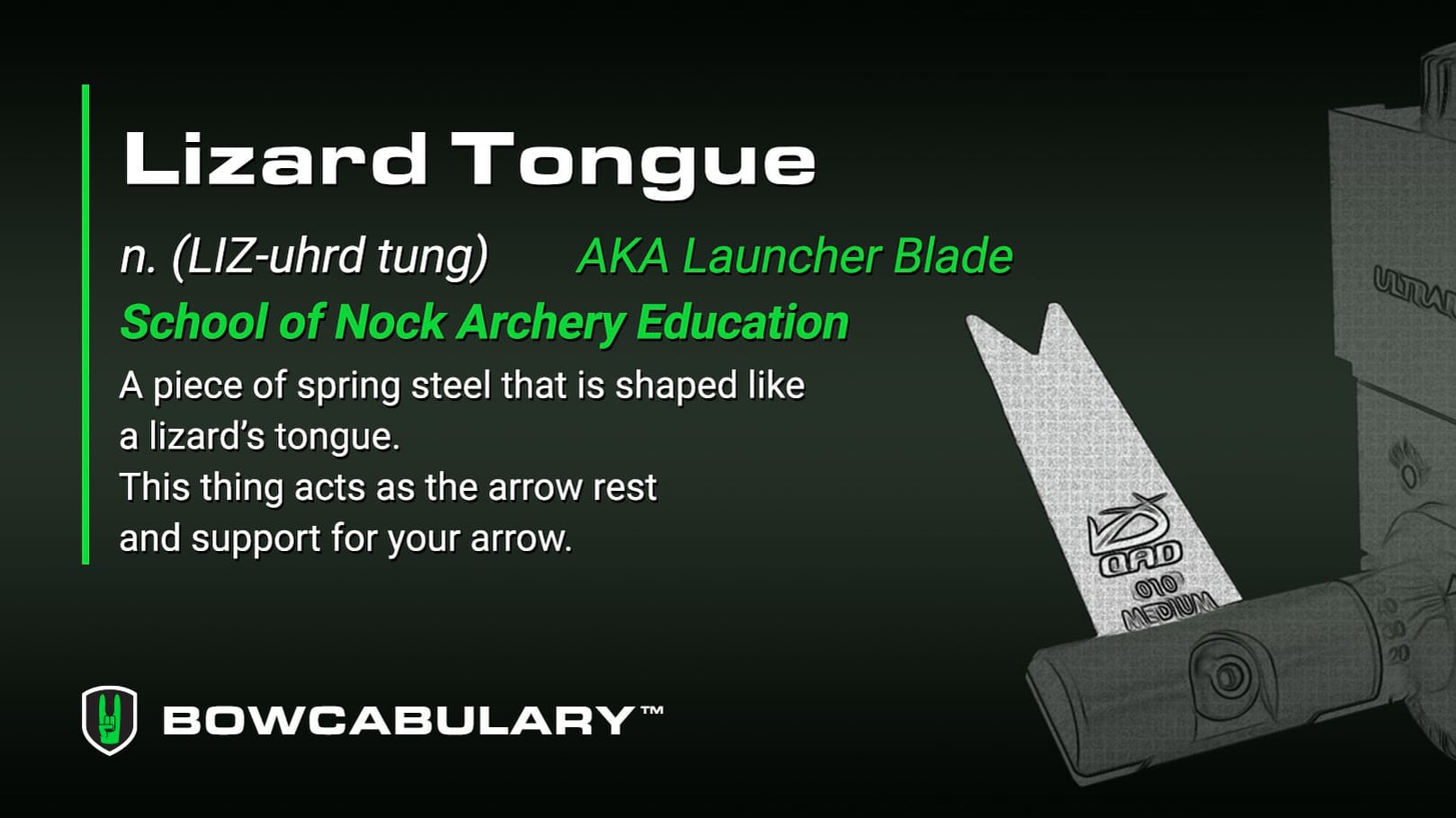
If you’ve spent time around target archers, you’ve probably heard someone say they’re “shooting a launcher” or “shooting a lizard tongue.” If you weren’t sure what they meant, this one’s for you.
A lizard tongue is a piece of spring steel shaped like a lizard’s tongue. This simple, non-movable blade supports your arrow on the rest.

Most hunting rests are limb-driven or cable-driven, and they drop completely out of the arrow’s path on the shot. A lizard tongue stays put, which makes arrow clearance and proper setup critical.
Why Target Archers Prefer Lizard Tongues
The appeal comes down to simplicity and repeatability. A lizard tongue gives you the same arrow response every single time. It has no moving parts, no cords to stretch during transit, and no limb travel to affect how the rest reacts.
For target archers shooting small-diameter shafts like the X10, Parallel Pro, or X10 Pro Tour with small fletching, that kind of consistency matters. To give you an idea of its real-world use and impact, I shot over 90% of my all-time best target archery scores on a lizard tongue for exactly that reason.
Sizing: Length, Thickness, and Width
Getting the right lizard tongue means matching three variables to your setup.
Length comes in three options: extra short, short, and long. Length determines how much support and flex the blade provides.

Thickness is measured in thousandths of an inch: .008, .010, or .012. The combination of length and thickness affects how the blade responds when the arrow is fired, including how much it sags under load and how aggressively it bounces back.
Width options include a narrow “freak” width, a standard width, and a wide option. The right width depends on your arrow diameter. A wide blade works great for a large-diameter shaft but will sit too deep on a micro-diameter arrow, putting the vanes in direct contact with the steel.

Clearance, Blade Angle, and Bounceback
The biggest challenge a lizard tongue poses is clearance. The blade doesn’t fall away, so your vanes must pass over it cleanly. Plastic vanes on a steel launcher leave zero margin for error, and any contact magnifies inaccuracy downrange.
Feathers are more forgiving, but most target setups run plastic vanes.
Bounceback is the other major factor. When the arrow launches and downward pressure hits the blade, it flexes. If the thickness, length, or blade angle isn’t dialed in, the blade can pop back up and strike the rear of the arrow.
Early designs with steep, near-vertical blade angles were especially prone to this. I found setting the blade angle to about 36 degrees was my go-to, providing solid support without the harsh snap-back.

The Trade-Offs
Durability is the main downside. These blades are thin spring steel, and they snag easily on pants or inside a bow case during travel. Bend one even slightly, and you’ve changed the rest position; your tune is gone.
Making the Switch
If you’re a bowhunter building out a target setup and you’ve already added a longer stabilizer, a smaller peep, a lens in your scope, or an extended sight, a lizard tongue rest is the next step you should consider. They are so damn repeatable.
Disclaimer: Expect a learning curve when dialing in the right blade specs and maintaining clearance. But once you’re past that, these rests are dynamite.