

Where my competitive archery journey began and my hunting accuracy was revealed. It was a sign on the road pointing to my first 3D shoot. I lost every arrow.
When I decided to start shooting competitive target archery, it wasn’t for the medals or the trophies. I wanted to become a better bowhunter. I knew success in a treestand or on a mountainside only happens when you can make one perfect shot the moment you get the chance.
I had years of hunting under my belt at that point and far more stories about “the one that got away” than I did animals on the wall. That all changed when I stumbled into my first 3D shoot.
I was driving back from applying for a winter job at Wilmot Mountain in Wisconsin when a road closure detoured me down some gravel roads in Spring Grove, Illinois. Halfway down one of those roads, a plywood sign spray-painted “ARCHERY SHOOT” caught my eye. I pulled in.
The lady at the table told me 40 targets were set up through the woods in hunting scenarios. I signed up on the spot with my brand-new bow from the truck. One hour later, I was 50% through the course and 100% out of arrows.
This real-world hunting-type scenario had just put 20 years’ worth of opportunities in front of me. I say 20 years because, prior to that, I was lucky to get one opportunity a year while deer hunting. This 3D archery wasn’t shooting at a hay bale in the backyard and hoping it’d work from a treestand. It was one hunting scenario after another, and each one exposed gaps in my preparation and knowledge of the foundations of proper technique and repeatable form. I was humbled on the spot.
The next day, I walked into the best archery shop I knew and made it a mission to figure this sport out. Four years later, I turned pro. Getting to that level came down to one lesson: learn how to eliminate mistakes. Trust me, I did make plenty of them in those early years. The point of these newsletters and articles is to show you the roadblocks and obstacles before you head right into them as I did.
Here are four big mistakes that can make you miss! But more importantly, how to fix them before they cost you in the field.
Test Your Gear Before You Trust It
My basic rule in archery is simple: any time you change anything, you have changed everything. I’ve proven this over and over through product testing. In target archery, nobody puts gear on the competition line without verifying it in practice first. This was an important lesson I learned early in competitive archery. You need to shoot it and test it before you can trust it.

I’ve seen many ads claiming “field point accurate,” but that’s rarely the case. When you do it and see it with your own eyes, you know it’s true.
That logic goes out the window in many of the hunting camps I visit every year. People show up, take a broadhead out of the package, and trust their entire summer of training to the written claims on the box. One marketing term hunters accept too easily is “shoots like your field points.”
Do yourself a favor and adopt an “I’ll believe it when I see it” approach. I test every component I plan to shoot at an animal on my range before I ever take it to the field. You owe it to yourself, and to the animal you’re trying to harvest, to practice with the same gear you’ll hunt with.

A perfectly tuned bow shot four identical arrows, each with a different broadhead, claiming accuracy. The results speak for themselves.
This goes beyond broadheads. Nocks, vanes, arrow spines: any component can shift your impact. If you want consistent accuracy on game day, put every piece of your setup to the test at home first.
Don’t serve yourself tag soup over a marketing claim you never verified.
I’ve had the opportunity to consult and test products for many companies in this industry. I’ve signed dozens of NDAs, and with some of those has come the reality that not everybody reports the truth. It’s a good reminder for any archer to run your own testing before trusting your season to someone else’s claims.
Consistency Allows for Accuracy, so Get a Peep Sight
If I handed you a BB gun with no rear sight to line up with the front bead, would you be accurate? You might hit the target once or twice, but you wouldn’t be consistent. Consistency in impact lets you sight in, and repeatability (thus accuracy) follows from there.

A peep sight gives you front-to-rear sight alignment, the single biggest factor in repeatable accuracy.
This is the basis of open sights on any rifle: a front bead and a rear slot give you two alignment points. A bow works the same way. You need a front sight (your pin) and a rear sight (your peep).
If you’re shooting a compound bow with a sight, get a peep, not a kisser button. I know some archers can be accurate at their home range on level ground without one, but that doesn’t carry over to hunting situations. I’ve coached enough people on this to guarantee you need one to shoot your best.
I learned as a target archer that smaller peeps produce tighter groups. In hunting conditions, you need a peep big enough to work in low light. Any size peep is better than none, but the smallest your eye can see through at last light is the one to run.
Without a peep, your eyes focus past the string straight to the front pin. In a spur-of-the-moment hunting situation, your brain is processing a lot at once, and without that rear alignment reference, the pin-to-string relationship drifts. That’s where you miss your mark.
I still have friends who refuse to use a peep sight. They’re always the ones who need more help on a blood trail, and too often those trails end without a recovery. Go to your local shop, find a peep that fits your setup, and start learning to center your pin housing inside it.
Take a Seat and Drop Your Draw Weight
Too many archers try to shoot the maximum draw weight they can pull. If you’re trying to be Superman on draw weight, you’re setting yourself up to miss when it counts.

If you can’t pull your bow easily from a seated position, you’re carrying too much draw weight for a hunting scenario. Too much pull weight is a leader in missed opportunities.
I’ve done this myself, and it cost me in a big way. Heavy draw weight made me struggle when nerves kicked in, wore out my shoulders, and gave me a bad case of target panic once I got rattled and couldn’t get the bow pulled back. If I could go back and change one decision of my career, it’d be leaving the heavy pulling bows alone. When I say heavy, just think of it like towing a trailer. If it’s taking 90% of your truck’s horsepower to tow that and you barely make it up the hard hills, then that is not where you want to be. Shoot for a weight that allows you to work with 75% effort, and you will always have horsepower left in the tank to overcome nerves and chills and awkward positions.
My rule of thumb for finding the right weight: point your bow level at the target and pull it back from a seated position without raising it above the target. If you can do that with ease, you’re at the right weight.
This matters even more for new archers, youth, and women. Too often, someone hands them a bow without lowering the weight enough for proper technique. They set it up for speed or distance instead of form.
Modern compound bows at 60 pounds are more efficient than bows from a decade ago at 70. Take advantage of that efficiency by shooting less weight. You’ll gain accuracy and spend more time practicing with better mechanics across the board.
Relax Your Grip
When adrenaline is pumping and the stakes are high, people make a fist. It’s a natural fight-or-flight response, and it’s one of the fastest ways to throw an arrow off target.
Looking back at my years of competitive shooting, I can see a direct connection between grip tension in photos and bad results at events. A tense bow hand and a tight grip on the handle affect accuracy every single time.
Keep your front hand and arm relaxed from the elbow forward. The only pressure in your front hand is the grip resting against the inside of your palm. Stay torque-free in the fingers.
I’ve made it part of my shot routine to consciously clench my fist, then relax it, and ask myself, “Are my hands loose?” Any added pressure on the bow handle changes arrow groups. If you’ve ever missed for no apparent reason and you know your pin was perfectly centered, then just know that tight hand pressure is one of the most common causes.

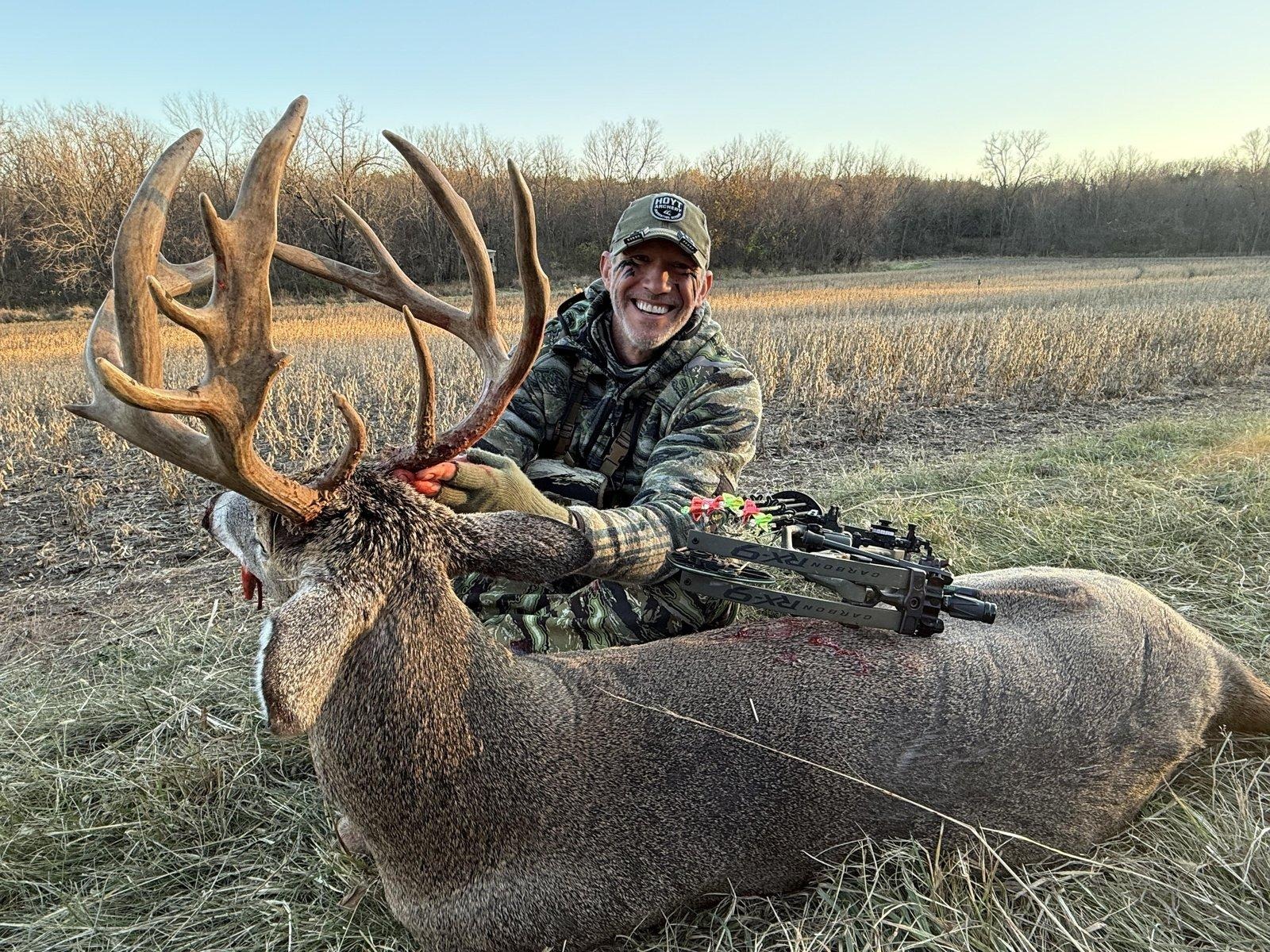
My success as a hunter boils down to lessons learned as a competitive archer. When your nerves are maxed out looking at a buck of a lifetime, you can’t afford any of these four mistakes. For this buck, I remember telling myself, be loose and relaxed.
Competition archery made me a better bowhunter. The tight matches and longer shots at targets put every flaw in my form and equipment choices under a magnifying glass. Hunting alone never gave me that level of feedback.
In my early years of bowhunting, I had more missed opportunities than successful ones. Since learning to eliminate these four mistakes, that ratio has completely flipped. Take note, take aim, and go fill a tag.