
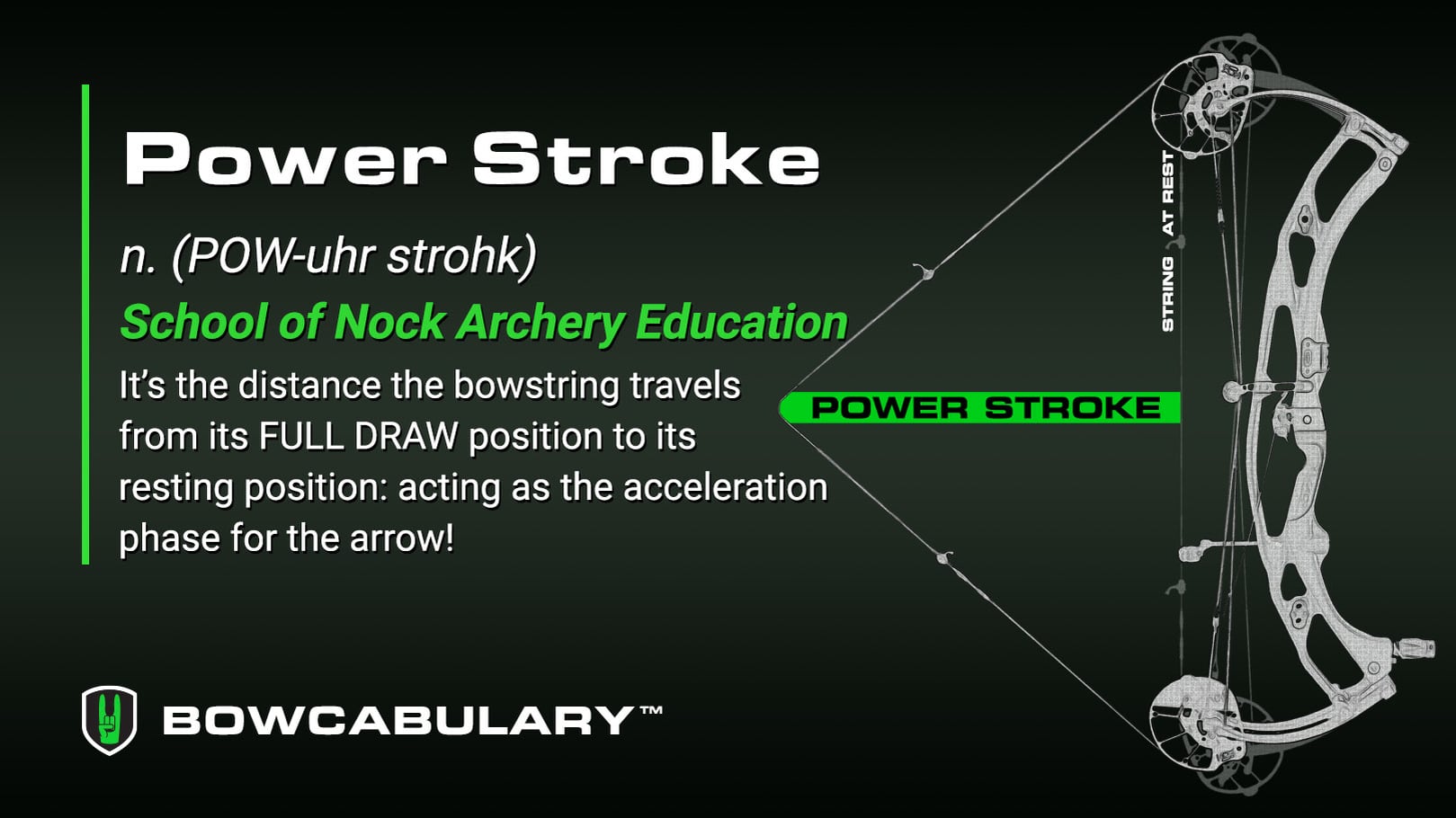
Power stroke is the distance the bowstring travels from its full draw position back to its resting position. It’s the acceleration phase of the arrow: the window of time the arrow is in contact with the string and being driven forward.
What Determines Your Power Stroke
Two variables drive power stroke length: draw length and brace height. Subtract your brace height from your draw length and you have your power stroke.
Take a 28-inch draw with an eight-inch brace height: that’s a 20-inch power stroke. Drop that brace height to six inches and the same draw length produces a 22-inch power stroke. Two extra inches, same archer, same draw length but a big difference in speed and possibly forgiveness.
That gap matters. As a rule of thumb, each additional inch of power stroke adds roughly 8 to 10 feet per second of arrow speed when all other variables stay the same. If you’re a 28-inch draw archer shooting the same bow model as someone at 31 inches, that three-inch difference in draw length produces a meaningful speed gap between the two setups.
Keep that in mind when you see advertised bow speeds. Manufacturers test at 30 inches of draw and 70 pounds of pull. If you’re at 31 or 32 inches, you’ll see more speed than the spec sheet shows.
If you’re at 27 or 28 inches, expect less. A bow rated at 340 fps at 30 inches, for example, is capable of closer to 356+ fps in the hands of a 32-inch draw archer. If you are on the lower side of that then expect less speed than advertised.
The Trade-Off: Speed vs. Forgiveness
More power stroke means more speed. The arrow stays on the string longer, too.
The longer that arrow is in contact with the string, the more opportunity you have to influence its flight, intentionally or not. Any added torque, facial pressure, or grip change during that acceleration phase will show up in your groups.
I built a bow for Joe Rogan I called “KONG” specifically for extreme speed. It was a high-reflex design with a very short brace height which maximized power stroke. It was also very high in pull weight.
The bow was blisteringly fast and nearly unshootable in the field. I couldn’t wear a hunting jacket without the string catching. That’s the extreme end of chasing power stroke at the expense of forgiveness and practical use. However, some archers want to have the drag car of bows and the brace height numbers sure factor in.

Bow manufacturers account for this trade-off. Archers with longer draw lengths are already generating speed through power stroke, so many long-draw cam systems are built with a higher brace height to add forgiveness back into the equation. The cam or limb geometry typically requires it anyway to accommodate the extra draw length.

Shorter draw archers often benefit from bows with lower brace heights. The reduced forgiveness is more manageable at shorter draw lengths, and the extended power stroke helps compensate for what’s lost in draw length alone.

Crossbows are an extreme examle of maximizing power stroke. Without an arm to worry about, manufacturers can design very short brace heights, and newer AR-style frames pull the string back considerably farther thpan older crossbow designs. Combined with heavier limbs, that’s where the performance numbers come from.
Find the Right Balance
The goal isn’t the most power stroke you can get. It’s finding the setup that gives you the speed you need, with enough margin for your technique.
A bow that punishes every small imperfection might look impressive on a chronograph, but it won’t serve you in the field when you’re layered up, cold, and making a shot that counts.
Know your draw length, learn how brace height affects your power stroke, and choose a bow that fits both your physical specs and your real-world shooting conditions.