

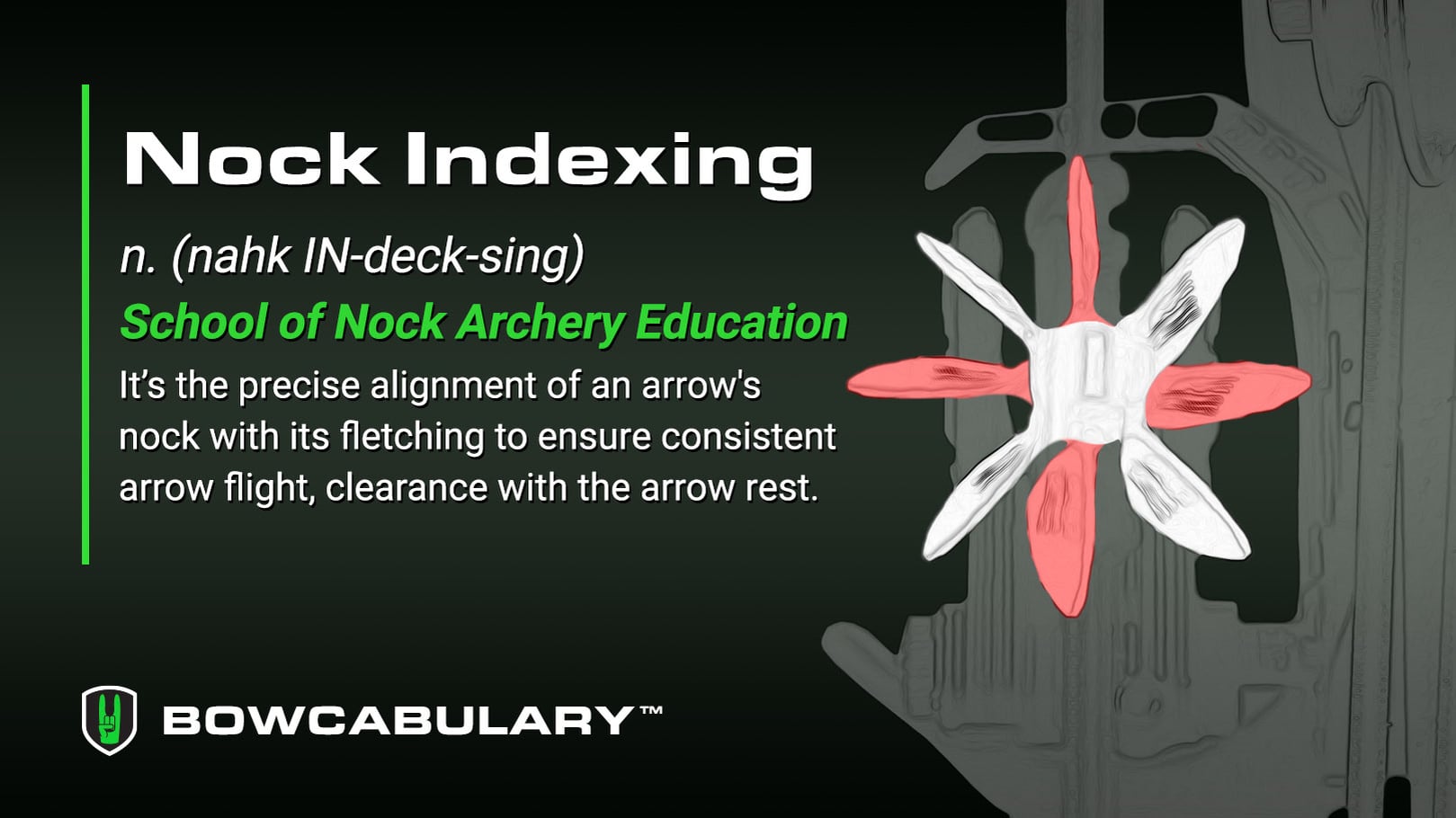
Nock indexing is the alignment of your nock in relation to your fletching.

Get it right, and your arrow clears the rest, cables, and riser cleanly every time. Get it wrong, and you’ve got a contact problem that will wreck your accuracy without making it obvious why.
Why Indexing Matters
Every time you nock an arrow, that nock snaps onto the string in a specific orientation. Where your fletching sits relative to the string at full draw determines whether your vanes clear everything in their path on the way out.

If the index is off, a vane clips the rest, grazes a cable, or catches the riser. That contact throws the arrow off before it’s had a chance to fly true.
The issue isn’t always dramatic. Sometimes contact is subtle enough that you don’t see it. You just see inconsistency in your groups and can’t figure out where it’s coming from.
How Fletching Setup Changes the Equation
Not all fletching configurations put the same demand on your index.
With offset or helical fletching, the vanes are already rotating as they leave the bow, so clearance is more forgiving as long as the index is in the right general position. Straight fletching is less forgiving. The vanes track a more direct path, which means they’re more likely to make contact if the index is off.
Vane height plays into this, too. Taller vanes need more clearance, which makes precise indexing more important. A setup running three-inch vanes can tolerate a little more error than one running taller-profile vanes.
Replacing a Nock Can Throw Things Off
One of the most common ways indexing goes wrong is through a nock replacement. It’s easy to assume a new nock will seat in the same orientation as the old one, but that’s not always the case. After any nock swap, check your index before you shoot. Don’t assume.

Use a dedicated nock tool to rotate the nock to the correct position rather than forcing it by hand. Forcing it risks cracking the nock or damaging the shaft, and a cracked nock creates its own set of problems.


How to Check for Contact
If you suspect a clearance issue, rub a little bit of lipstick (yes, lipstick) on your vanes, then shoot. If your vane is contacting anything, then you’ll see a mark on your rest, your riser, or maybe even on your cable. The lipstick will leave a mark anywhere the arrow made contact. It’s a simple, fast way to confirm whether your index is costing you.
If you find contact, adjust your index until the arrow clears cleanly, then recheck. A clean pass-through means your setup is dialed in.