

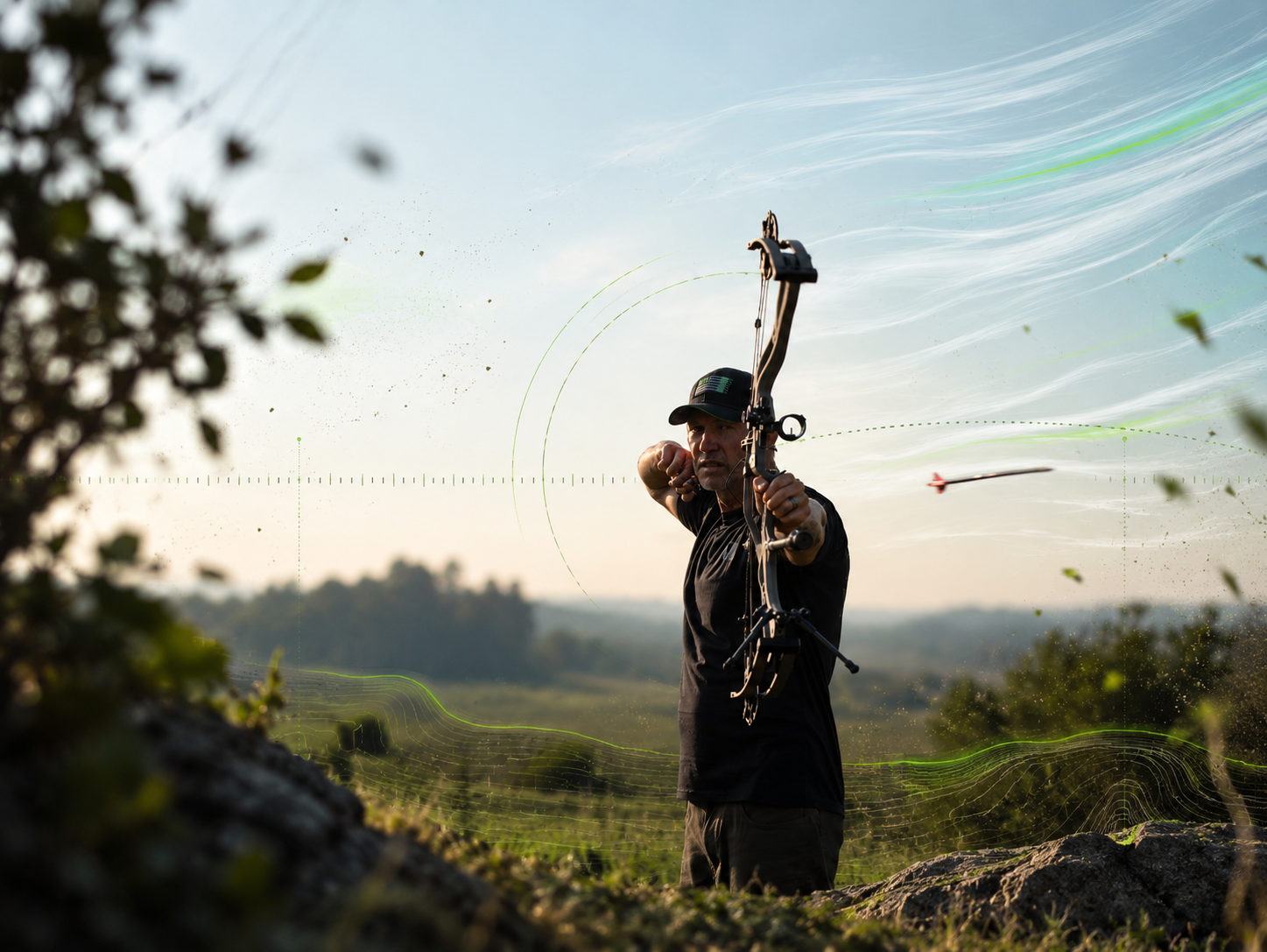
Every archer has stood at their shooting position feeling completely calm, only to watch their arrow drift wildly off target. Such is the work of one of bowhunting’s greatest tricksters: deceptive wind conditions.
I faced this scenario during a recent shoot. My target was a 3D hog positioned across a dry creek bed, about 60 yards away. While the shot distance itself wasn’t particularly challenging, the environmental factors demonstrated why paying attention to details separates good archers from great ones.
Today, I’ll break down how to read deceptive wind patterns, time your shot perfectly, and make adjustments that ensure accuracy when conditions threaten your success.
Reading Deceptive Wind Patterns
Standing at my shooting position, I noticed a marker that would’ve been easy to miss if I wasn’t paying close attention: Near the target, a small pink ribbon (our exit marker) kept shifting directions.

While I felt no wind at my shooting position, that little ribbon told a different story.
The main breeze was ripping right to left down through the creek bed, creating a wind funnel. However, at the target location, swirling eddies were causing the wind to shift between left to right and right to left in unpredictable patterns. Meanwhile, I was standing in a protected pocket where no wind was detectable.
This is why so many bowhunters miss in field conditions. They judge wind based on what they feel at their shooting position, completely missing what’s happening along the arrow’s flight path or at the target.
Always look for natural wind indicators positioned at different points between you and your target. Ribbons, grass movement, leaves, or even dust signal wind currents you can’t feel. Pay special attention to indicators near your target, since this is where accuracy matters most.
The Art of Patient Shot Execution
With the wind shifting unpredictably, I needed to wait for the perfect moment when conditions would let my arrow fly true.
This patience distinguishes disciplined archers. I drew my bow multiple times, waiting for that perfect window of opportunity when the wind temporarily calmed. I let down without shooting twice because the conditions changed during my draw sequence.
Notice the pattern here: Observe, prepare, and commit, but only when conditions are right. This approach also applies to bowhunting scenarios where you might have a small window to execute a shot on a live animal.
Follow my proven shot execution checklist:
- Identify your wind indicators
- Wait for a lull in the wind pattern
- Begin your draw sequence when conditions look favorable
- Let down if conditions change mid-sequence
- Execute by committing intently on your window of time when conditions are right
Critical Technical Adjustments for Challenging Shots
Besides wind reading and timing, I needed to adjust other technical factors to make this shot successful.
Precise Ranging
Brush partially obscured the target, which meant I risked ranging an object in front of it.

My solution was to take multiple readings, targeting specific parts of the animal: its white tusk, its ear, and right underneath its neck to the bank behind. The lattermost number went up a yard, proving my first two were right.
This confirmed my distance at just shy of 60 yards.
Stable Footing
I noticed my front foot was slightly toe-down on the uneven terrain, creating an unstable shooting platform. Before my final attempt, I corrected this by placing a small rock under my front foot to level my stance.

This small adjustment made a huge difference in stability.
Clearing Obstructions
Overhanging branches created another challenge. Not only did I need to time my shot around the wind, but I also had to account for branches that would occasionally blow across my shooting lane, completely blocking the target.

I needed to wait for the wind to calm and the shooting lane to clear.
Putting It All Together
When all the elements finally aligned (stable footing, clear shooting lane, and a momentary lull in the wind), I executed the shot confidently. The arrow flew true and struck exactly where intended.
This approach to shot execution has helped me develop the discipline and awareness I need to land ethical, effective shots in high-stakes hunting scenarios.
It’s All in the Details
Details matter tremendously in archery. The difference between a perfect shot and a complete miss is often the time spent adjusting for factors many archers overlook. That time separates amateurs from pros and pros from elite pros.
When you’re facing a challenging shot, whether in competition or hunting, take an extra moment to assess all the variables. Look along your arrow’s entire flight path. Be patient enough to wait for the perfect window, and be disciplined enough to abort when conditions change or you find yourself waiting rather than making it happen.
These habits won’t just improve your tournament scores. They’ll make you an effective, ethical bowhunter who can execute with confidence when that once-in-a-lifetime opportunity presents itself.