

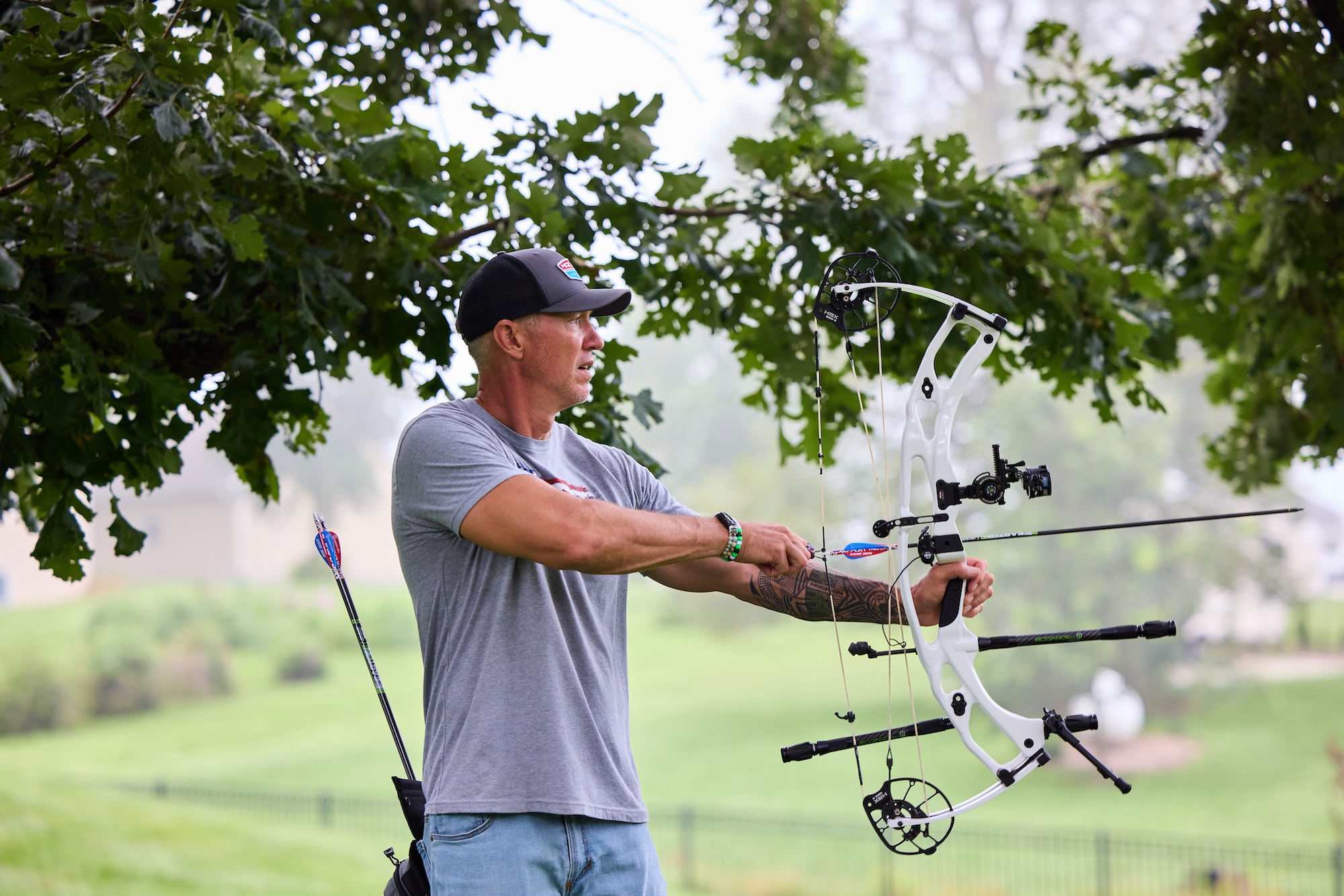
Seven pounds of draw weight doesn’t sound like much on paper. I wanted to find out what that gap actually looks like across different arrow setups, so I put two Hoyt RX-10s through a chronograph test with four of my favorite Easton shafts. One bow sits at 66 pounds, the other at 73.

I’ve been working up from my summertime practice weight of 60 pounds to my peak hunting poundage, building over a few weeks to keep my form clean under the added draw weight. I’m at 66, and by next week I’ll hit 73. Before I make that final jump, I wanted to lay out the real numbers so you can see what a seven-pound difference produces at my 30.5-inch draw length with four different arrow weights.
For the full setup and tuning breakdown on these bows, check out my guide on setting up the Hoyt RX-10.
Four Arrows, Two Draw Weights

Even with a 100-grain difference in arrow weight, all my shaft options are inside the circle at 20 yards. BUT WHAT ABOUT 60?
Both bows are Hoyt RX-10s set up identically except for draw weight. I ran four Easton shafts through each bow, with arrow weights from 445 grains up to 547 grains: the 5.0 at 445 grains, the Sonic 6.0 at 460 grains, the Axis at 514 grains, and the FMJ at 547 grains. The FMJ is about 100 grains heavier than the 5.0, so the spread across these four shafts gives you a good picture of how arrow weight interacts with draw poundage.
Here’s how the speeds broke down:
| Arrow | Weight | 73 lbs | 66 lbs | Gain |
| 5.0 | 445 gr | 299 fps | 282 fps | +17 fps |
| Sonic 6.0 | 460 gr | 294 fps | 278 fps | +16 fps |
| Axis | 514 gr | 280 fps | 266 fps | +14 fps |
| FMJ | 547 gr | 271 fps | 259 fps | +12 fps |
Every arrow picked up double-digit speed from seven extra pounds of draw weight. The lighter 5.0 gained the most at 17 fps, and the heavier FMJ still picked up 12 fps. Lighter arrows gain more speed per pound of added draw weight, but the trend holds all the way down the lineup.
Once you move past a few pounds of separation between two setups, the performance gap stacks up fast. At my typical hunting weight of 73 pounds, the 5.0 is already pushing 299 fps at 30.5 inches. That’s a number I’m happy with for a 445-grain hunting arrow.
What Those Numbers Mean in the Field

Accuracy stays the same between these two bows with the arrows I tested. My groups look identical at both poundages. The poundage advantage shows up in what the arrow does after it reaches the animal and what it does at longer ranges, which is very common in western hunting.
Seven extra pounds of draw weight give your arrow more speed and momentum when you’re punching through heavier bone or running larger cutting mechanical broadheads. Those extra fps pay off on a quartering shot or when the broadhead catches a rib on entry.
I’ve been building from 60 pounds over the summer to 66, and by next week I’ll be at 73, my peak hunting weight. The numbers at 66 are already more than adequate for every North American species I hunt. I run the heavier draw weight as a personal choice for the extra margin it gives with the broadheads I shoot, but also for the option to go from deer to moose within the month of September. I will use the T2 broadhead for all hunts this season, and with these numbers it’s an easy choice to have maximum cut without sacrifice.
If you’re working through your own seasonal bow switch, I laid out the full process in my blog post on transitioning to hunt mode.
Draw What You Can Control

Today’s lower-poundage bows are more than lethal for any North American species, especially when paired with the right broadhead. Don’t let the speed numbers push you into pulling more weight than you can handle.
The biggest factor in choosing your draw weight is whether you can control it and operate the bow with ease. Draw level, let the bow down quietly, and do it from a seated position without sky-drawing or creating a bunch of movement. If you can meet those standards and move up in poundage, the speed numbers climb in a hurry.
If you can’t draw smoothly or you’re making big movements to get to full draw, drop the weight back down. A clean, controlled shot on the animal will always outperform a sloppy release backed by extra fps. For more on building that consistency, check out my secrets to better groups.
The numbers I ran on these two RX-10s are real, and they carry value in the field. But accuracy and clean, quiet bow handling will always count for more than any reading on a chronograph.