


Whenever I’m teaching a class with national teams, I always open with a quote from Bud Fowkes: “Archery is a two-step sport. Step one: Learn to shoot a 10. Step two: Repeat step one.”
That applies to the Mindset Monday I just shared, where the message was simple: More than one path leads to the top of the mountain. Right after I deliver Bud’s quote in my presentations, I follow it up with the line I always pair with it, “There are always exceptions to the rules.”

The Two-Step Sport
Learning how to shoot a 10 matters. The next part of the equation is putting one in the middle, over and over, until that consistency becomes who you are as an archer.
Not everyone takes the same path to that 10. Not everyone has the exact same way to step 2 to repeat it. But step 2 is the key! What way allows you to repeat it? Is it YOUR way or THEIR way?
If you’re watching this or reading this, you’re looking for coaching, advice, and help. Plenty of people give coaching out there, and some of them are exceptions to the rule. What I teach is trusted by so many national teams and coaches because its simple basics allow for the mass majority of archers to duplicate what they see from me.
Some archers have techniques that are world-champion level but aren’t necessarily repeatable. In my presentations, I show photos of several of the greats, all world-class archers, but that doesn’t mean they have a technique I can teach to the masses. I TRIED MANY OF THEM, with loss of accuracy and time.
When World-Class Form Won’t Translate
Take the release hand position as one example. One of the best 3D archers of all time is Jeff Hopkins, and he has the most vertical release hand I’ve ever seen with a handheld release. There is also facial pressure that many of us don’t have.
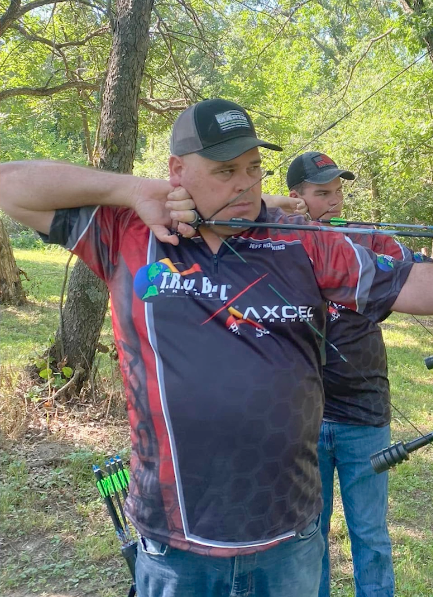
For many people, that extreme angle would be hard to replicate. It applies so much torque to the D-loop and string that any variation causes downrange problems and inconsistency. Jeff can do it his way every single time. That’s what makes Jeff, Jeff.
Reo Wilde is another world-class archer, and he runs a tremendous amount of back weight along with a tremendous amount of front weight on his stabilizer at times. When I competed against him, I knew I could never hold that much weight that far out in front without manipulating my technique, compressing my shoulder, and leaning back into the shot.

That approach worked for me at one distance, yes. But it fell apart once I got to multiple distances, multiple angles, and multiple conditions.
It works for a world record holder. It didn’t work for me.
The same applies to people like Dejan Sitar in Slovenia, who held world records shooting a wrist-strap release. The wrist-strap release sometimes worked for me, but often it was disastrous. Not for Dejan; he was amazing with it, and I admired shooting with him and his style.

Tim Gillingham is another whose techniques are extremely unorthodox, and he also teaches a lot so i handle a lot of messages from folks trying to duplicate it with fail. People sometimes get frustrated watching these elite-level archers, and then can’t duplicate the outcome based on the same method to get to the top of that mountain.

Building Technique That Transfers
When you’re exploring the different paths to the top of the mountain, you have to be smart about it and also realize pretty quickly which ones come to a trailhead where you’re not seeing the outcome you need. The internet lets us learn from many people, but that doesn’t mean their way will work for us if they’re the exception to the rule.
I’ve based my coaching and technique on what I believe the largest percentage of archers can replicate and learn. The goal is for them to learn step one (shoot a 10) and step two (repeat step one). The fundamentals I teach for compound archery come from the same foundation you find in most elite-level recurve Olympic archers: foundation, anatomy, structure, and using less to get more.


I wasn’t one of the exceptions to the rule. I was an average person with the ability to shoot a bow, with a strong willingness to put in work and apply different lessons to my technique. Probably my best instructor was mistakes; I’ve done it wrong so many times that I learned what not to do more than I learned what to do.
Find Your Own Path to the Top
If you’ve been following someone and it’s not working, including me, don’t change what’s totally working for you to go with what someone else tells you. A great way to look at it is all the coaches who tried to tell Tiger Woods his swing wasn’t efficient or wasn’t good.
The reality is, Tiger was at his prime when he was swinging his way. When he tried to make it work the way everyone said he should, based on efficiency or what computer analysis told them, his game started going backward.
Focus on what you can repeat. That’s the most important focus for any student of the sport.
Exceptions to the rule will always exist. More than one way leads to the top of the mountain. Find out which way is best for you so you can stay there as long as you possibly can.