
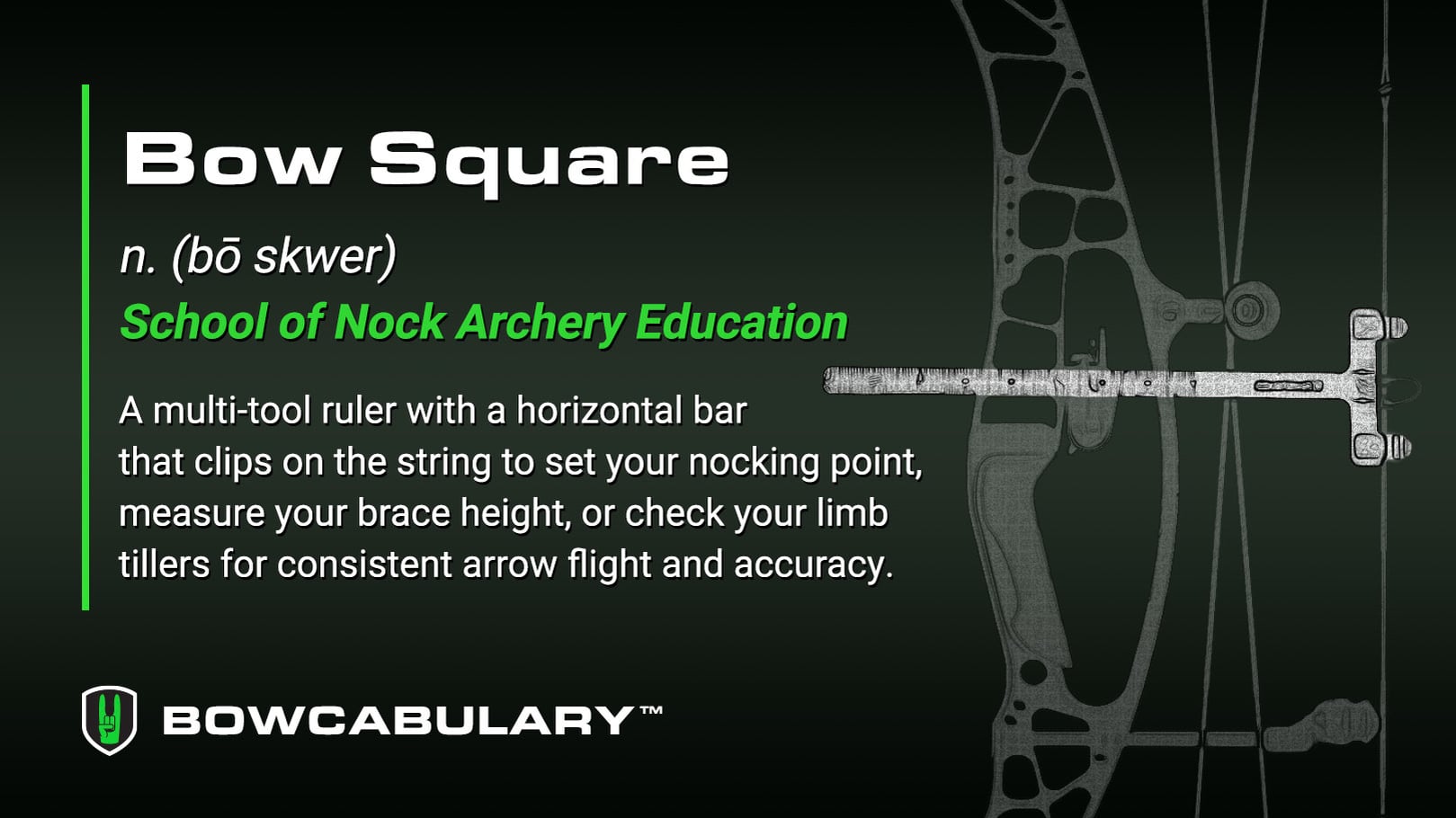
A bow square, sometimes called a T-square, is one of the most basic and useful tools you can own as an archer. It’s a small ruler with a horizontal bar that clips onto your bowstring, giving you precise measurements for arrow tuning, nocking point placement, brace height, and limb tiller.
If you don’t already have one in your kit, it’s time to fix that.
How a Bow Square Works
The design is simple: A straight ruler runs vertically with a perpendicular bar at the top that clips onto your bowstring. Once it’s clipped on, you can slide it up or down along the string to take measurements at different reference points.
Most bow squares have both metric and standard markings, so you’re covered no matter which system you prefer. The horizontal bar holds the tool in place on the string, keeping your hands free to work.
Two Styles to Choose From
I’ve used two different styles over the years:
- My original bow square (shaped like a T) has a wider clip that wraps around the string area with space between the clips.
- The newer style (shaped like an L) has an offset clip that stays out of the way when you’re measuring nocking point position or D-loop placement.
The newer style is nice when you’re working around the nocking points or using D-loops on compound bows. It gives you more room to see what you’re doing. Both styles get the job done, so pick whichever feels more comfortable in your hand.
What You Can Measure
Here’s where a bow square earns its place in your kit:
- Brace height: Set the T in the throat of the grip and measure the distance to the string. Recurve archers use this constantly since they unstring and restring their bows regularly. That measurement tells them the string has the right number of twists, which keeps draw weight, poundage, and sight tape consistent.
- Nocking point position: Set the bow square on the string and reference the Berger button hole or arrow rest launcher to determine exactly where your nocking points or D-loop should go. Once you have this set, you can mark the nock position on the square and use it to check if your serving has ever slipped and changed the nock point position.
- Limb tiller: Set the bow square on each limb where it meets the riser and check the measurement to your string. This tells you if your tiller adjustment of the limbs is balanced and if your tiller is set correctly for consistent arrow flight.
- Peep sight position: With an arrow nocked and a D-loop installed, set the bow square on top of the nock and measure the distance to the center of your peep. This gives you a reference number you can check anytime.
Mark It and Make It Yours
Once you’ve got your bow dialed in and shooting the way you want, take a permanent marker and put reference lines on your bow square at your key measurements: brace height, nocking point, peep position.
If you don’t want permanent marks, lay a strip of Scotch tape over the ruler first. Mark the tape, and if you change your setup later, peel it off and start fresh.
Those marks turn your bow square into a personalized diagnostic tool. Pull your bow out of the case at a tournament, a 3D shoot, or in elk camp, clip on your bow square, and you’ll know in seconds if anything has moved during travel.
Get One and Keep It
A bow square costs a few bucks and lasts a lifetime, assuming you don’t lose it. It’s one of those tools that target archers, especially Olympic-style shooters, always have on hand. Bowhunters should do the same, because a hunt is no different than a tournament of a lifetime. MEASUREMENTS MATTER!
Knowing your key measurements and being able to verify them on the spot gives you confidence that your setup is right before you ever draw back on a target or an animal. That peace of mind is worth every penny.