

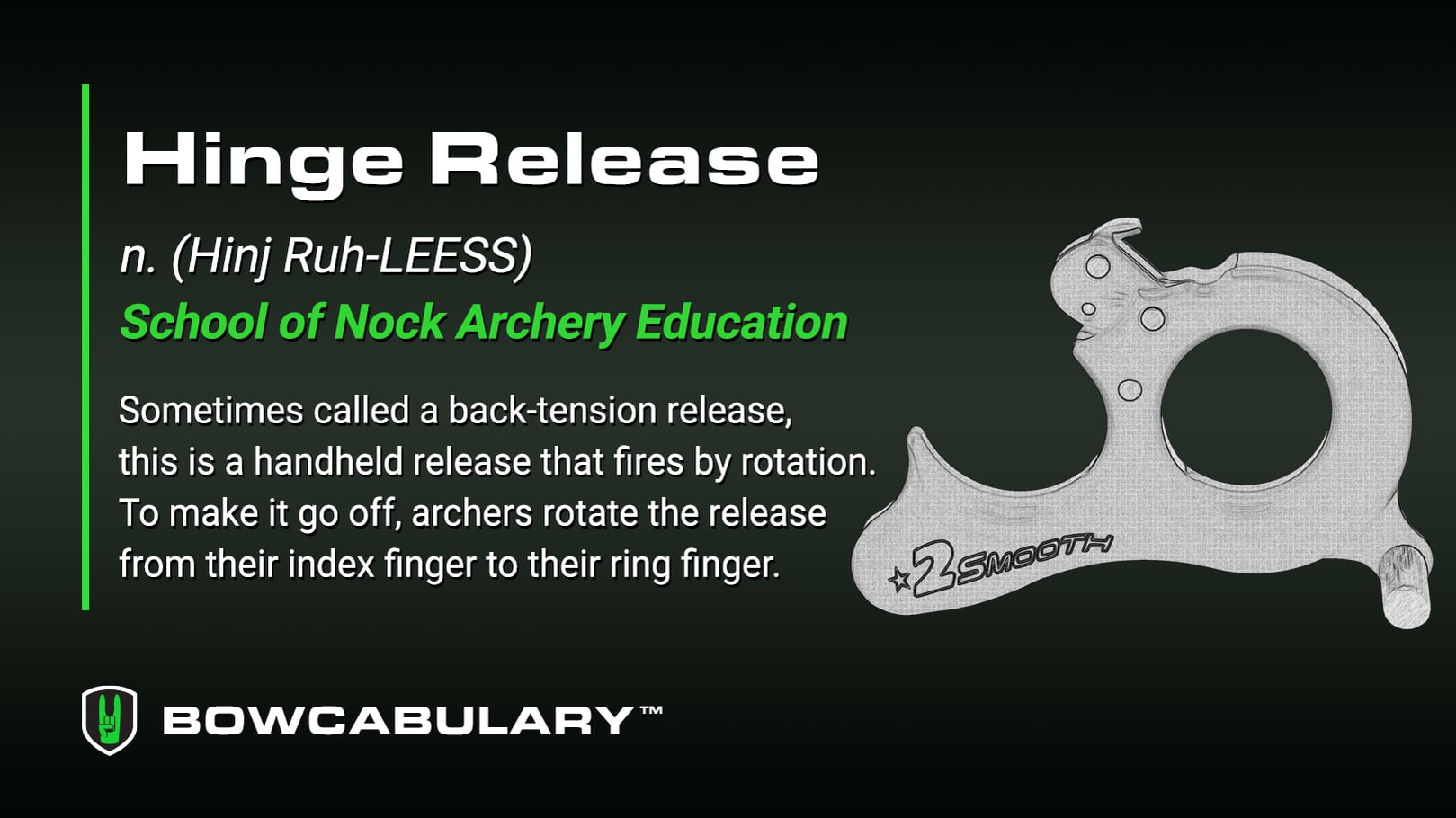
A hinge release, sometimes called a back tension release, is a handheld release aid that fires by rotation.
It’s one of the four categories of release types in your complete shot sequence, and each category gets its name from the way it fires. The hinge release is often the most misunderstood of the four, and one of the scariest to try if you don’t know how it works.
How a Hinge Release Works
Picture a teeter-totter. That’s the simplest way to understand what’s happening inside a hinge release head’s construction.
The release has a head that pivots on the body. The jaw sear that hooks onto the D-loop has a flat, sharp edge (called a jaw sear) that rides along a half-circle component that’s on the body of the release called the moon.
As the archer rotates the release, the jaw sear travels along the moon’s surface. When it passes the edge, the jaw opens, and the string goes. Just like a trap door.
The rotation comes from added pressure on the middle, ring, or pinky finger, which makes the release pivot around the middle finger. To stay safe during the draw or let-down, keep all your weight on the index finger and thumb side of the release. Your release hand is everything when it comes to controlling this process. Anytime you draw or let down, your pressure should only be on the index side of the release body, which prevents the jaw sear from pivoting towards the edge of the moon.
That’s the grounded side of the teeter-totter. As soon as you start shaping your middle finger and adding rotation, you’re moving toward the firing point by shifting the weight over to the other side.

Firing the Release
Archers fire a hinge release in different ways, but the core idea stays the same: slow, controlled rotation.
One method (my preferred method) involves slowly relaxing the index finger once you have shaped the middle finger into position. As the index finger relaxes, the release pivots around the middle finger, and the release fires. The more relaxed and fluid the movement, the smoother the shot breaks.
This is what made hinge releases so important for archers dealing with target panic. The hinge was the first release type that based the shot process on the element of surprise.
You’re not punching a trigger. You’re building into a shot that breaks when the rotation reaches its threshold, and since you can’t see it, the trap door can flip at any time based on your rotation speed.
The other method of getting a hinge to go off is to slowly curl your middle, ring, or pinky finger, which shifts the weight away from the index finger, causing the hook to glide along the moon to the edge.
The Clicker
Some hinge releases come with a clicker. This is a small indentation on the half moon, positioned right before the edge where the jaw falls. As the sear hits that indentation, it produces an audible or physical click that tells you you’re right on the edge of firing.
Clickers are useful for beginners. They act as a safety indicator and help prevent over-rotating into an accidental misfire. A lot of new hinge shooters set up their release so they rotate to the click, then slow down, focus on aim, and work through the last bit of travel to fire.
But over time, any audible paired with a physical reaction builds an association in your brain. That association can turn into anticipation, and anticipation leads to what archers call “yips.” Every rep you take is a chance to program your mind over time, for better or worse.
For that reason, once you’ve learned the functionality of the release, shooting without the clicker adds one more element of surprise to your process.
Our 2 Smooth Hinge, which is very popular, has two independent moons. One moon controls whether or not you have a click. If you choose to, you can adjust the distance of the click and how quick or slow it will fire once the jaw sear reaches it. You can also adjust it so there is no click. The other moon controls how hot or cold you want the speed to be for firing once you are shifting the weight on the release body.
Randy Ulmer’s Approach
Randy Ulmer, who taught me how to shoot a hinge release, took the surprise factor even further. He carried a release pouch with multiple identical hinge releases, each with the moon set to a different position. He’d reach in, mix them up, and pull one out at random.
One release might fire with very little rotation. Another might take a lot more travel to go off. One in the pouch didn’t fire at all!
By never knowing how much rotation the next release needed, he kept his brain from building an association with the firing point. This philosophy solidifies my personal opinion of the click. Good for a short window of time, but then has potential for anticipating it. Preventing anticipation is really what makes this release important to understand. That kind of disciplined, deliberate repetition is one of the secrets to tighter groups.

Putting It All Together
A hinge release fires by rotation, not by a trigger pull. Keep your weight on the index finger and thumb side when drawing back or letting down, and you stay safe.
The rotation, the moon, the sear, the teeter-totter concept: Once you understand those mechanics, the hinge goes from intimidating to one of the most effective tools for building a surprise-based pull and finish to your shot.