

If you’re a hunter, you’ve probably never heard this term “BARRELED”. If you’re a target archer, there’s a good chance you have.
Either way, barreled shafts completely changed target archery, and understanding them gives you a better grasp of the arrow technology on the market today.
Defining the Barreled Shaft
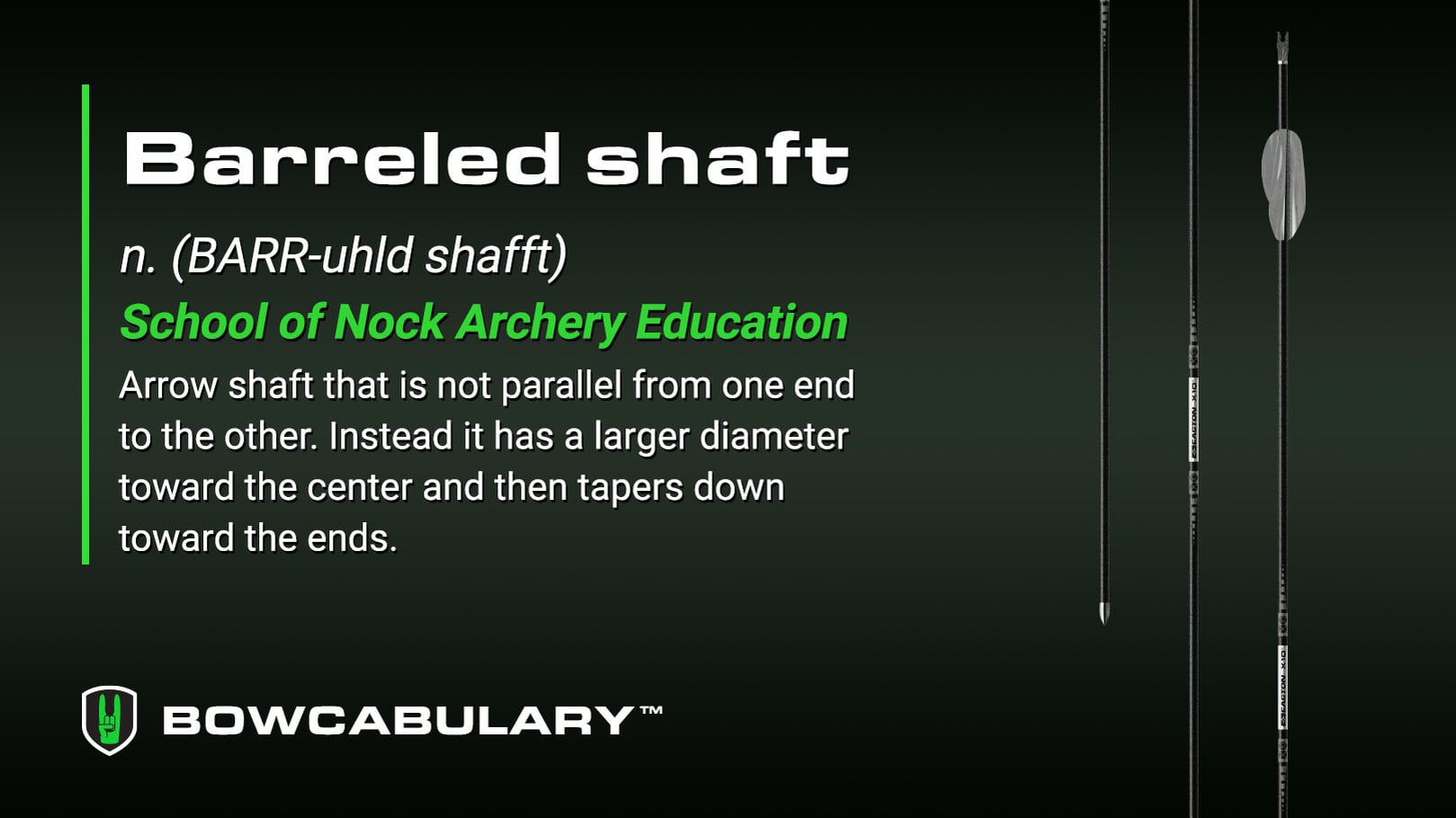
A barreled shaft is an arrow shaft that is not parallel from one end to the other. Instead, its diameter is largest toward the center and tapers down toward both ends. Think of a whiskey barrel, and you’ve got the picture. THESE ARROWS ARE EXTREMELY ACCURATE IN LONG RANGE WEATHER CONDITIONS.
Wind is the reason barreled shafts exist. In Olympic target archery, archers shoot at 70 meters and a lot can happen in wind drifting. The less it’s drifting the more accurate you can be. Back when I competed in full FITA rounds, we shot out to 90 meters. At those distances, wind was even more of a deciding factor every time you stepped into a medal match.
By reducing the diameter on both ends of the arrow, barreled shafts minimized drag and wind drift. The reduction in drift relative to parallel shafts was significant, as confirmed by crosswind studies. If you are an archer starting to explore your arrow shaft options and what they mean in different formats of archery then this is one you should know more about. It’s not for everyone, and isn’t great in hunting situations but if you are looking to being accurate at long distances then this is the one.

The ACE and the X10
The first barreled shaft was the A/C/E. It was a very small-diameter arrow for its time, extremely lightweight, which allowed archers to get more speed out of their bows. Many competitors did very well with the A/C/E, and for a time, everyone at the Olympics was shooting them.

The A/C/E was responsible for my first US Team selection.
Then, in 1996, the X10 showed up at the Olympic Games with Team USA and dominated. The X10 took barreled technology and reduced the diameter even further, but boosted the overall weight. More mass with less surface area. That made the X10 superior to the A/C/E, which was already superior to parallel shafts.

The X10 set a new standard in the Olympic Games and has crushed the competition ever since. At 70 meters, regardless of conditions, archers absolutely pound tacks with these.

The X10 changed the game for me at 90 meters.
Why Barreled Shafts Are Complex to Tune
The largest diameter sits toward the center of the arrow, and that barrel point affects spine behavior as the arrow flexes during launch. As you cut off the front of the arrow and get closer to that thicker center section, the rate at which the arrow stiffens accelerates.
For compound archers, cutting off the back was even more dramatic. The back of the shaft sits closer to the barrel’s thickest point, so trimming the back stiffened the arrow at twice the rate of cutting the front.

Compound bows drive more force on the back of the arrow than recurves. And the paradox is different: with a release aid, the arrow flexes vertically rather than horizontally as it does for finger shooters. That made tuning barreled shafts for compound bows a real challenge.
For my setup, I was shooting a 410 X10 at 61 pounds with a 31-inch draw. I cut two inches off the back and went with a 110-grain tungsten point up front.
On my A/C/E, that same two inches off the back made the arrow too stiff. What adds more complexity to the situation is the types of points you can put in the arrow can change how the arrow tunes. The ACE’s bulge points used a longer insert that stiffened the shaft more than the tungsten point on the X10.

Two very different recipes, but the results on paper were the same. Figuring that out was the hard part.
The Modern Evolution
A few years later, the Pro Tour came along as a hybrid. It was barreled from the front up to the thickest point, then parallel from there to the back. That eliminated the need to cut from both ends. You’d choose your spine, cut the front, and use different point weights to find your tune.
Today, that barreled technology has been simplified into parallel arrows designed with compound archers in mind. The X10 Parallel Pro is a good example. It’s not the same as a fully barreled X10, but it carries the aerodynamic benefits with far less tuning math. This arrow is much more expensive than the FMJ, 50 or AXIS and the advantages aren’t are high as comparing an X10 to the them. But its worth noting.

If you like the idea of what a barreled shaft offers but don’t want to go that deep into the setup, the X10 Parallel Pro is your next best option. It’s my opinion for hunting situations you are still better to elect the FMJ, AXIS or 50