

The winter months usually bring breaks in a home routine. It’s a big reason why New Year’s resolutions rarely work. Many of you in the outdoor community are traveling for trade shows, conventions, family holidays, weekend basketball tournaments, and the list goes on and on.
Most archers understand that consistency builds skill. Fewer recognize that the biggest threat to their progress isn’t poor form or inadequate equipment. It’s the disruption of travel.
When your routine breaks down on the road, so does your shot process. Here’s how to prevent that from happening and why your release hand deserves more focused attention than you’re probably giving it. Use these travel times to build this critical part of your archery arsenal!
The Hidden Cost of Inconsistent Training
Travel creates a perfect storm of excuses. No range access. No bow. Limited time. Distractions everywhere.
But here’s what I’ve learned after decades of competitive archery: The athletes who reach the top are the ones who find ways to train regardless of circumstances.
When you’re constantly starting and stopping your training, you’re not just losing practice time. You’re actively working against the imprinting process that builds reliable execution under pressure.
The School of Nock curriculum emphasizes building habits, discipline, and mental preparation. All of that work unravels faster than anything when you hit the road without a plan. Those distractions compound, and suddenly you’re back at square one, wondering why your shot feels different than it did two weeks ago.
The solution is simpler than most archers realize. It doesn’t require a full archery setup, a target range, or even much time. It requires knowing what matters most in your shot and training that element through focused repetition.
Why Your Trigger Is Everything
If I had to identify the single skill that separates good archers from great ones, it’s trigger control. Not draw length. Not a sight setup. Not even bow tuning.
The way your hand interacts with your release aid determines more about your consistency than any other variable.
Most archers treat their release like a light switch. They cock it and punch it, cock it and punch it. Every single repetition is imprinting a poor habit that will surface at the worst possible moment, usually when a mature buck is standing broadside at 30 yards.
I’ve watched this pattern destroy countless opportunities. The archer draws back, settles the pin, and then something happens in their brain. Instead of executing the shot process they’ve theoretically practiced, they revert to that punch-and-hope pattern they’ve actually imprinted through careless handling of their release.
If you’re constantly changing your trigger style, your brand, your tension settings, or the travel on your hinge releases, you’ll never really improve. You have to train all the time with the same equipment you’ll hunt with.
Release training strips away everything except the core skill. No arrows flying downrange means no physical fatigue from shot volume. No target retrieval means no wasted time walking back and forth.
No bow in hand means no distraction from aiming, arrow rest positioning, or sight picture. You’re focused entirely on execution.
Building a Road Training System That Works
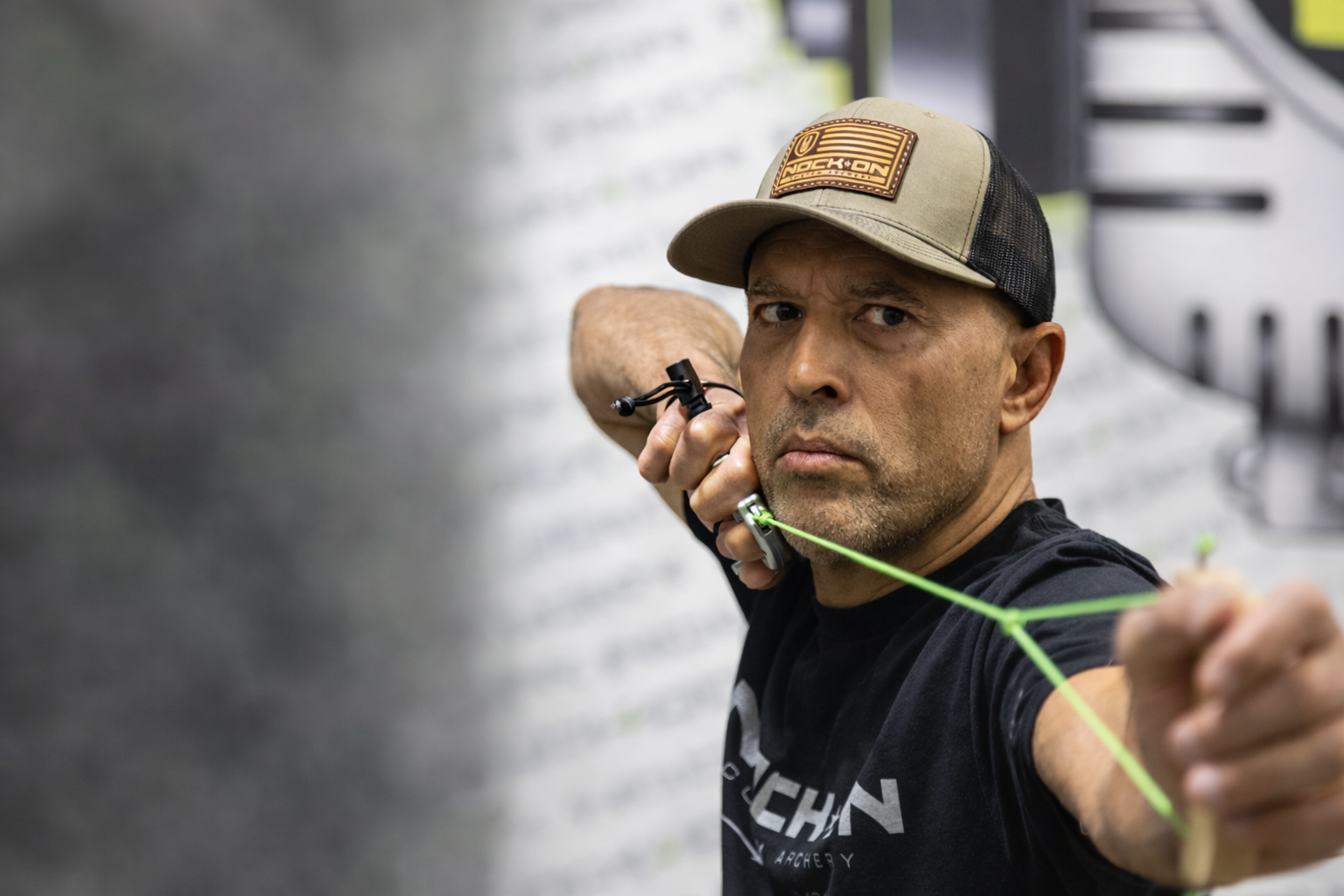
Our Release Trainer changes everything about what’s possible on the road. It’s a simple tool that lets you practice the most important element of your shot anywhere you have two minutes of quiet time. I made one decades ago and never looked back. This isn’t some elaborate training device; it is a consistency imprinting tool. They are inexpensive and invaluable.
What is so important about this tool is that you aren’t fighting the weight of your bow. The only tension on it is what you put on it to mimic yourself at full draw. This allows you to focus on the details of the release hand and its position on the release, the position of your anchor, and the pressures of the fingers and thumb, while not worrying about the bow lurching forward. You can concentrate on the micro-details.
The Core Drill
The process is straightforward but requires deliberate attention:
- Cock your release and attach it to the trainer string.
- Focus on where the release is positioned in the hand.
- Make it feel the same every time.
- Mimic drawing back to your anchor position, feeling the exact placement of your hand against your face.
- Imagine looking through your peep and visualizing a sight on whatever you like aiming at.
- Shape your thumb to the trigger without firing. Learn how much preload you can have on the trigger without it going off. This presentation skill alone requires hundreds of reps to get right. Master the preload!
- Now bring attention to the tip of the rear elbow and imagine pulling it to the wall behind you. Pull through the shot using your back muscles, allowing the release to open naturally without having to change your thumb pressure from the preload on the step before.
- The Release Trainer lets you observe three critical things: your hand position, rocker angle, and trigger contact point.
This drill’s real value is the ability to actually watch what your hand is doing. When you’re at full draw with a bow, you can’t study your release hand without breaking position or the bow taking it away from you. With a trainer, you can look directly at your grip, see how your rocker position changes the trigger location on your thumb, and feel the exact amount of pull required for activation.
I practiced tens of thousands of repetitions this way, often during other activities: on phone calls, watching hunting footage, especially during travel downtime. Those reps built an unconscious competence that showed up when it mattered most.
Adapting for Different Release Styles
This training method works regardless of your release type. For tension releases, focus on finding your anchor, softly disengaging the safety without changing hand position, and pulling smoothly until execution. The key is learning that let-off point where the release becomes active without immediately firing.
For hinge releases, the string trainer is particularly valuable. I’d set my first hinge so laser-hot that I couldn’t safely draw a bow with it. Mainly because I didn’t understand how it functioned.
The only option was practicing with a string until I understood the mechanics: how pulling with back muscles causes natural hand rotation, which finger pivots the hinge head and breaks the shot. That foundation made me a completely different archer.
For thumb-button triggers, the drill emphasizes presentation without firing, shaping the thumb around the barrel, and then adding gradual pressure through continued back tension rather than independent thumb movement.
Expanding Your Road Training Beyond the Release
Release training forms the foundation of portable practice, but complete road preparation includes a few additional elements for some Extra Credit in Class!
Keep a portable target available. A small bag target in your truck bed or back seat means you can shoot real arrows even in limited spaces. Hotel parking lots at dawn, hunting camp clearings, warehouse loading docks.

I’ve put thousands of arrows into targets in unconventional locations. Close-range practice is still practice, and it keeps your full shot cycle sharp.
Integrate fitness that travels. Jocko Willink is a close friend to the Nock On Nation. He has a release trainer, Silverback, and takes it on the road. But he has some great advice for training principles that translate perfectly to hotel rooms and cramped spaces. One minute of push-ups, one minute of sit-ups, one minute of burpees, one minute of squats, then rest. Repeat it four times.

Simple circuits that require zero equipment maintain your archery’s physical foundation. Toss a few Jocko Hydrate Sticks in your travel bag to stay on top of electrolytes during these sessions, especially if you’re training in the heat or after a long day on the road. They are always in my quiver at TAC events in the summer. I have them on me, so I use them!
Carry resistance tools. A bungee strap weighs nothing and provides sufficient resistance for drawing simulations and back-engagement work. Combined with your release and shot trainer, you’ve got a complete system that fits in a small bag.
The mindset change matters as much as the equipment. Building a habit means doing it consistently, not just when conditions are perfect. Travel is an opportunity rather than an obstacle when you approach it with the right tools and the right perspective.
Making It Automatic
THE RELEASE HAND is the connection between you and your bow, and it needs to be AUTOMATIC.
This repetition has one goal: When you draw back on an animal, your release hand should know exactly what to do without conscious thought. All of it should be so deeply ingrained that it happens automatically as your conscious mind focuses on the animal’s vitals and the shot opportunity.
That level of unconscious competence doesn’t develop from occasional practice sessions when everything aligns perfectly. It develops from thousands of reps performed consistently, including during travel, during busy seasons, and during times when the easy choice would be to skip training entirely.
Your release hand is the final link between all your preparation and the arrow finding its mark. Every other element of your setup exists to put that hand in position to execute. Treat it with the attention it deserves, and your results will reflect that investment.
Start today. Put a release in your pocket. Build or buy a simple shot trainer. We have several videos on training drills with your Release Trainer here on the Nock On website. Use them!
Make the commitment that travel will strengthen your training rather than interrupt it. The compound effect of consistent practice, maintained through every disruption and distraction, is what separates archers who plateau from archers who continually improve.