

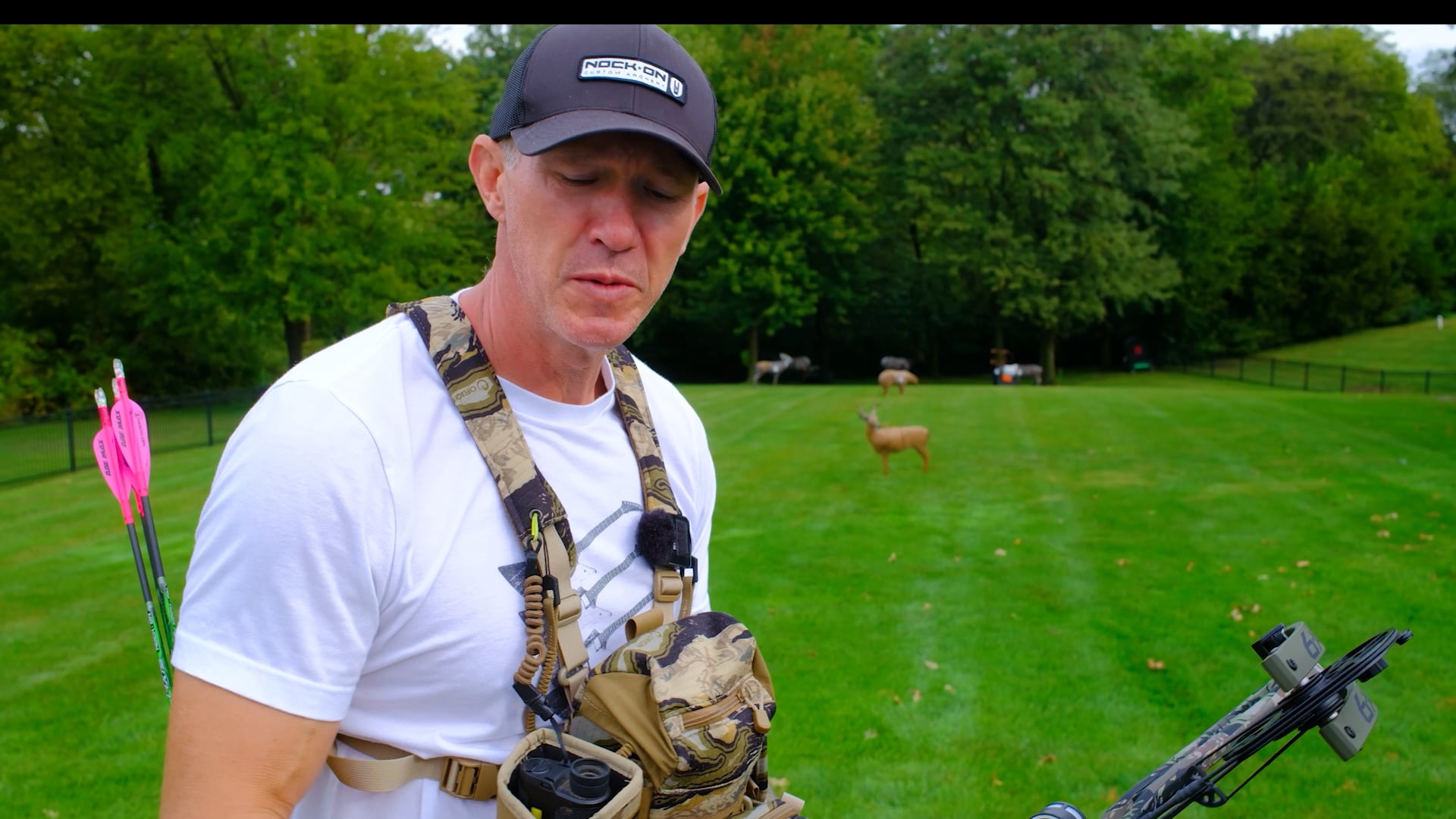
When I first switched from a traditional multi-pin sight to a two-pin movable sight, it wasn’t love at first sight. (No pun intended.)
It took me several years to fully embrace the system and develop the habits that now make it second nature in the field. What started as an adjustment period has become a tactical advantage that’s paid dividends on hunts across all kinds of terrain and scenarios.
If you’re considering making the switch or already have but haven’t quite cracked the code, I’ll walk you through my exact setup and the mental approach that makes this system deadly when it matters most.
The Two-Pin Advantage
The principle behind using a two-pin sight well is developing what I call “dual-pin awareness.” Unlike a traditional fixed multi-pin setup, where each pin represents a predetermined yardage with no ability for individual precision, the movable two-pin system requires a different mental approach.
The most important habit (and one that took me consistent practice to build) is automatically checking both pin positions whenever you adjust your sight. When I dial my top pin to a specific yardage (let’s say 47 yards for that big bull), I immediately look to see where my second pin falls (60 yards in this case).
This isn’t optional. It’s mandatory every single time you touch that dial. Set the top, know the bottom. Repeat those numbers in your head.
This habit creates a tactical advantage in the field. If that bull stands up and takes a few steps back after I’ve ranged him at 47, I don’t have to scramble to reset my sight. I already know my second pin is sitting at 60, giving me an immediate backup plan without any additional movement or adjustment.
In those seconds where opportunity meets preparation, this awareness can be the difference between punching a tag and watching your season continue.
My “Home Base” Setup for Tactical Readiness
Whether I’m in a stand, still-hunting, or on a stalk where an animal could appear at any moment, having a strategic “home base” setting is advantageous.
After testing configurations over the years, I’ve landed on a setup that provides maximum versatility for most hunting scenarios:
My preset:
- Top Pin: Set at 25 yards
- Second Pin: Automatically falls at 40 yards
(This is based on my personal setup, speeds, and ballistics.)
This configuration isn’t random. It’s tactically purposeful. The majority of bowhunting shots happen inside 40 yards, and having these two distances as my fixed references means I’m ready for most encounters without touching my sight dial.
What makes this approach so useful is how it allows you to cover additional yardages through what I call “reference point shooting.” Here’s how it works:
20-yard shots: When an animal appears at 20 yards and my sight is set with the top pin at 25, I place my aiming point just over the top of the pin, which results in a slightly low impact. Through practice, I know exactly how much the arrow will rise from that position. You’ll also need to learn your own drop when holding over.
30-yard shots: At 30 yards, I do the opposite of the 20‑yard hold. I place my top pin slightly over the spot I want to hit to compensate for the arrow’s drop.
35-yard shots: Around 35 yards, I begin referencing my second pin. Instead of holding under the target like I do at 20 yards with the top pin, I now hold the second pin slightly under the spot I want to hit.
45-yard shots: At 45 yards, I use a gap between my second pin (40 yards) and the top of my bubble, which corresponds to roughly 52 yards with my sight in its home‑base position. Knowing the relationship between your top pin, second pin, and bubble gives you a third reliable aiming reference without touching your sight.
Once you’ve practiced enough to understand these reference points, you can confidently take ethical shots across a wide range of distances without ever having to adjust your sight in the fast moments. That’s huge when a rutting bull or a wily whitetail comes charging in to your calls or a buck materializes in a shooting lane with no warning.
Field Application and Practice Strategy
Implementing this system well requires dedicated practice that mimics hunting scenarios.
Start by setting your pins at the home base configuration (25 and 40 yards for me, though your optimal settings may vary based on your bow’s speed and your hunting environment). Then work through these practice scenarios:
- Close-range drills: Practice shots at 20 yards using your 25-yard pin as a reference point. Learn exactly where your arrow impacts when you aim just over the top of your pin.
- Standard-distance proficiency: Become automatic at your exact pin settings (25 and 40 yards in my case). Find a place where your two pins can be at common distances.
- Gap-shooting practice: Place targets at 30 and 35 yards and practice holding between your pins. Try holding high with the 25-yard pin or low with the 40-yard pin. With repetition, you’ll develop precise mental references for these in-between distances.
- Extended-range emergencies: Position a target at around 50–55 yards and practice using your bubble level’s top edge as an aiming point. This isn’t ideal for hunting situations, but having this capability can be useful in certain scenarios.
Nock On Training Target Teaches Gaps
Our Nock On Training Bag Target has two built-in aiming points that help you learn your gaps mathematically. One side features a crosshair for French tuning and ballistic‑drop evaluation. If you prefer a simpler visual, the opposite side has a large long‑range dot you can use to study your ballistics.
First, aim at the center with your preset top pin, then measure the rise or drop of your arrow when the distance is variable. With my 25‑yard pin, the arrow rises about two inches at 20 yards and drops roughly three inches at 30 yards.
The real field application comes when you make ranging a tactical exercise. When I stop to call for elk or set up on a deer trail, I immediately identify and mentally mark multiple reference points: “That fallen log is 25, the clearing edge is 40, and the big pine is 53.”
This mental mapping means that when an animal appears, I already know which reference point to use without fumbling for my rangefinder.
Speaking of rangefinders, I rely on my Leupold RX-FullDraw 5 to build these mental maps quickly. Its Flightpath Technology shows me the actual arrow trajectory and any potential obstructions, which is a huge help when I’m setting up in a new spot and need to identify those reference points fast.
Building Confidence Through Deliberate Practice
The two-pin movable sight system isn’t better or worse than a traditional multi-pin setup. It’s just different, with its own set of advantages that become apparent once you’ve learned the approach.
Why It’s More Precise
The two-pin movable sight gives you the ability to be exact to the yard with either of the pins whenever you have the time to range and reset. That’s the best part. If a buck is feeding at 36 yards, you can dial to the exact number and smoke it with no guesswork. That accuracy advantage shouldn’t be overlooked, even though I now prefer fewer pins. You get complete precision and a smaller scope housing, which means more clearance, pinpoint accuracy, and better peep‑to‑scope ratios.
The key to making it work is developing consistent habits for the moments when you can’t range and reset the sight exactly. Habits like always knowing both pin positions, establishing a tactical home-base setting, and practicing with your reference points until they become second nature.
What I’ve found most valuable about this system is the confidence it builds. When an animal appears unexpectedly at 20, 40, or even 47 yards, I don’t have to think through a complicated process. I simply reference my mental map, select the appropriate aiming point, and execute the shot. The system has simplified my bowhunting process and expanded my shooting range without additional mechanical adjustments in the moment.
Like any aspect of archery, this approach requires deliberate practice. But once those habits are established, you’ll have a versatile system that’s ready for whatever the hunt throws your way.