


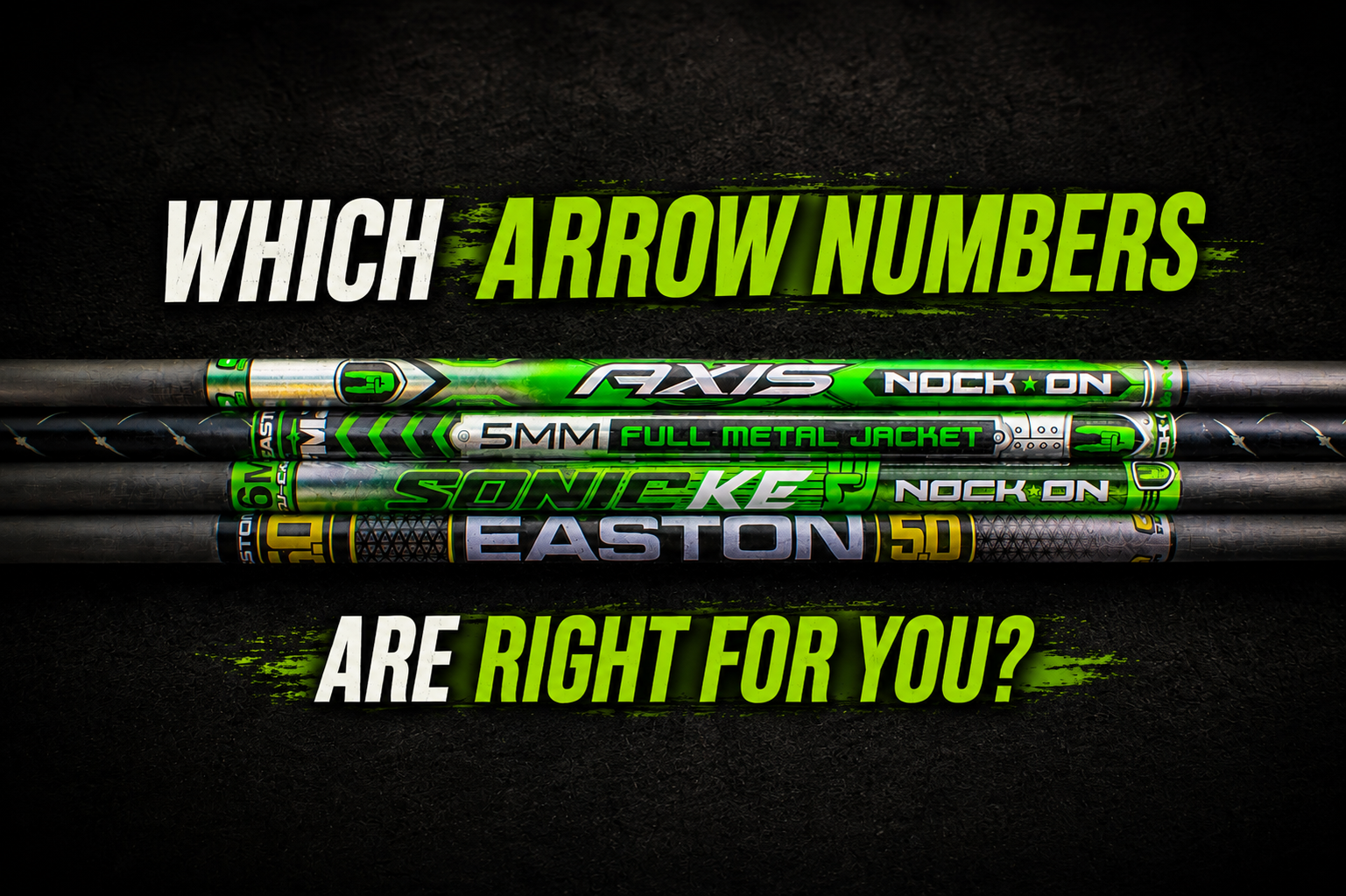
One of the most common questions I receive is, “What arrow do I use for hunting? Do I want it heavy for maximum penetration, or do I want it lighter for the speed benefits?”

Since most hunting opportunities only offer one shot, you better have picked the best arrow for YOU!
It’s an important question for a hunter to ask, but the unlimited variables make a definitive answer hard to pin down.
Many, many, many times I’ve run the numbers from a heavy arrow to a faster arrow to see how the performance changes in a hunting situation. My short answer to all of you: You’re splitting hairs. The numbers aren’t crystal clear when only considering speed, kinetic energy, or SLUG numbers.
Certain animals require a heavy arrow for maximum penetration. A buffalo or even a hippo, for example. Those are close-range opportunities where speed and pin gapping don’t have much of a factor.
If you’re a North American hunter focused on deer, antelope, elk, turkeys, and other game, I’d put less emphasis on playing the numbers. With the gear available right now, the performance is there regardless. The animals here in North America give us the ability to exercise multiple options on arrow choices.
The reality is other factors are more important for the hunter when considering arrows. Let me walk you through the variables I know matter for your decision-making.
Accuracy Is Everything

We offer four arrows that have a proven track record and allow us to build the best shooting hand-fletched arrows in the game.
In recent years, more and more studies on arrows have created a divide. Some of the numbers start to distract folks from what matters most: accuracy.
Having the right arrow matched to your bow and broadhead choice is what makes it hit the same spot again and again. This can’t be overlooked. Place the arrow in the right spot and good results follow, regardless of how fast, slow, light, or heavy the arrow is.
No matter what arrow configuration you choose, practice is what assures arrow placement.
I want to say this from the heart for all of you reading this and trusting me. I’ve established a solid career in the archery community. I view my career much differently at 50 than I did 30 years ago as a pro archer.
After all this time, I still do a lot of R&D for companies in the industry. What separates me from many others is that I can pick and choose who I work with. I don’t need paychecks or sponsorships from companies and, in fact, say “no” all the time, even when it would be financially advantageous.
What matters to me are products I know are good for myself and all of you who trust me. I don’t speak negatively about products or testing I don’t like. I focus on talking about what makes me and my students the most accurate with the products I prefer.
The arrows we build here at Nock On Archery are the ones I’ve built for myself for years and years, based on accuracy and success.
The arrows in all my videos and the groups you see me shooting every day on social media? Those come from arrows I order from our shop. It sounds crazy, but it’s true.
Our team can build them better than I can at this point. I did the homework on the range and figured out what shafts, what fletching configurations, and what front weights offer the best results for accuracy. Then we offer them.
I have four favorite arrows right now: the AXIS, FMJ, 5.0, and Sonic KE. Some offer the weight; some offer the speed. Some have higher specs and more durability; others have fewer options but at a better budget.
Regardless of the pros and cons, none of them sacrifice accuracy. With all that in mind, let me walk you through some of the numbers I look at.
Straightness and Consistency
Let me talk you through my way of thinking for selecting arrows.
The most critical factors with any arrow are straightness and arrow spine consistency. Never cut corners on these two if you’re serious about accuracy.
Modern archery equipment pushes speeds much higher than bows from five years ago. A simple rule applies: The higher the speed, the more the inconsistencies in an arrow are magnified.
When the arrows aren’t consistent, even a world-class archer can’t be consistent with them. Add in speed and broadheads, and the instability compounds. I couldn’t have shot the scores I did in competition or had the success I’ve had in hunting with arrows that don’t match each other.
Spine consistency, the uniformity in the thickness of the arrow wall, is one factor. The other is the consistency in straightness. Some companies share these numbers with you, and 0.001–0.002 is what I stand behind.
Weight matters, too, but it usually goes hand in hand with consistency in the arrow thickness and straightness.
Choose an arrow with strong spine consistency, matching weight, and tight straightness tolerances. You’ll see the most accuracy out of your setup across any number of fletching and broadhead configurations. Not every manufacturer advertises their consistency or straightness numbers, but they’re worth asking about.
Match Grade Made Easy

Match Grade means you are using the cream of the crop!
For nearly 20 years, I’ve been a huge fan of the AXIS, the FMJ, and now the 5.0 shaft, but in the Match Grade. This is the small label you see on the top-of-the-line shafts.
Match Grade Pro Shop Series arrows go beyond industry standards with Easton’s exclusive five-point straightness scrutiny. Other brands only test for straightness at the midpoint of the shaft. Easton Match Grade shafts go through a far more exacting process, with tolerances checked at both ends, the center, and the critical quarter locations.
This is money well spent. The Match Grade option is now available on the 5.0 arrow shaft, too.
A long time ago, Easton didn’t have this selection process available to everyone, but the elite shooters had access to it. As a US Archery Team member, I was able to get arrows called “selects.” They made sure all my arrows were sorted out of the bulk arrows to get the ones that were the straightest with matching weights.
Why? That’s what produced the best scores downrange. Over time, this selection process became available to everyone through the Match Grade selects.
Added Value in Front Weight

Our arrows come standard with 50 or 75 grains of heavy-hitting inserts. Most companies only offer a cheaper, lightweight aluminum option.
The reason I was drawn to the AXIS and FMJ 20 years ago was their tolerances in a 5mm diameter arrow and the option to use the brass/stainless steel 50/75-grain HIT inserts to increase the front weight of the arrow (F.O.C.). It wasn’t a standard option, but I liked adding extra weight to the front of the shaft. This allowed me to use a 100-grain broadhead but boost the overall front weight with the insert instead of the head itself.
I had so much success with this added brass/stainless front weight that I wanted it as a standard option with any of the Nock On arrow shafts we offer on the website. I think it needs to be mandatory. Having a heavy point weight isn’t the same as having a heavy insert weight.
Most heavy broadheads have much more surface area than the compact 100-grain heads. With that added surface area, they’re harder to tune. By putting weight in the insert, you can still use the more compact broadheads that fly better. Again, accuracy is everything.
The heavy inserts are added value and a standard option for anything we build here, unless you specify otherwise. By using the 50/75-grain inserts and increasing the front of center, I found I could shoot both mechanical and fixed blade heads with a much smaller variance between them.
The higher F.O.C. (front of center) allowed me to shoot a shorter vane to control those broadheads, which has its own benefits. Back in the day, people usually used four- to five-inch vanes for broadhead control. Now the three-inch vane is pretty standard.
A smaller fletch has less ballistic drag, which helps maintain speed on longer shots and performs better in a crosswind. Both of those factors come into play in western-style hunting. The average opportunity is further away out west than in a tree stand situation, and open country usually has more wind to deal with.
The bottom line: The heavy inserts increased my front weight and helped boost my overall arrow weight.
Higher F.O.C. allows me to shoot a more compact broadhead (which I find flies best) and still maintain a better front-of-center balance. Most compact broadheads are 100 grains, but when combined with a 75-grain insert, you’ve got some amazing front steering weight.
My arrow configuration was a 300 spine with a 75-grain brass HIT and a 100-grain G5 broadhead. Overall arrow weight was around 520 grains. (Keep in mind I have a 30.5-inch draw and cut my arrows to 29.5 inches.)
That 500-grain number may seem high to some of you with a shorter draw length or less pulling weight. In those situations, one more option is worth looking at.
The Sonic Boom

The Sonic KE is such a great option for hunters on a budget.
Several years ago, Easton had an arrow tucked away in the catalog that wasn’t gaining a lot of attention. I was a big fan of its predecessor, but it now had a new name and was made in America: the Sonic.
When I first saw this arrow, I noticed it was a light arrow, which I normally don’t prefer in hunting. The tolerance and construction process was amazing, though, and immediately got my attention.
I started looking at components and realized the Sonic could use a brass HP insert, which lets the shooter boost the overall weight of a normally light arrow and increase the F.O.C. The heavy inserts weren’t standard, though.
With that in mind, I ordered a set of arrows and a pack of brass inserts. After building my first set, I was amazed at the accuracy. One of the most accurate builds I’ve ever had for the price.
This led to the Sonic KE Nock On arrow we offer, which comes only with the 50/75-grain inserts. They’re more budget-friendly than the AXIS or FMJ and have consistency in weight, spine, and straightness.
The standout advantage of the Sonic KE was that you could get them prefletched from the factory at a lower cost. You can get three dozen of the Sonic KE for the price of two dozen AXIS.
My final conclusion: I’d use the speed and accuracy of the Sonic KE on anything up to an elk. I’d use them for spot-and-stalk mule deer where a longer shot might be needed and less wind drift in open country matters. I wanted the speed for whitetails during the rut, when deer move fast and the ability to range your target is nearly impossible.
The speed saves you when you have to make an instant guess on distance. Turkeys and hogs, which rarely quit moving, fit right in with higher speed that gets there quick when the shot angle is right.
Most importantly, these arrows were consistent and repeatable. I want to be clear on that. If this arrow hadn’t had the tolerances it does, a fast, inconsistent arrow wouldn’t have been an option.
Missing faster is still missing. A fast arrow must be absolutely perfect in consistency; otherwise you’ll magnify your inaccuracy.
The New 5.0 Arrow

The 5.0 arrow has taken the industry by storm over the past year. Its super-lightweight, high-modulus carbon construction is exceptionally tough, and when combined with heavy front inserts, it creates a killer combination with excellent F.O.C.
One last number to consider is the 5.0. This is a new arrow shaft built like an AXIS but with a higher modulus carbon fiber that’s lighter without sacrificing any durability.
It’s been popular for good reason. The grains-per-inch (GPI) numbers of the shaft open up your overall arrow build. In a 300 spine, for example, the 5.0 is only 8.4 GPI, compared to the AXIS at 10.7 GPI or the FMJ at 12.0 GPI. That weight difference adds up fast on a 29-inch arrow.
With the lighter 5.0 shaft, you have a lot of options. You can rig it up like your AXIS or FMJ but end up with an arrow that’s lighter and faster. Or you can use more front weight or add a lighted nock and almost match the overall weight of an AXIS with only the 50-grain insert.
Final Thoughts

Don’t shoot yourself in the foot with the wrong choice on arrows. Great arrows = great groups!
Today’s archers and bowhunters are serious and have more access to information than ever before. Sometimes that information lets you get lost in details that don’t add up on the range.
Not all numbers matter in archery, but some of them do. For arrows: straightness, consistency, front weight, reps on the range, and the size of your groups.
You’re like me. You want arrow setups that can bust through ribs and bust nocks on the range. The details I covered today are valuable pieces of information.
Accuracy is the most lethal killer. You can never neglect putting in the work, but some tools give you a better chance of success.

Excellent explanation as usual. Can’t say enough good things about John Dudley. Thanks agsin