
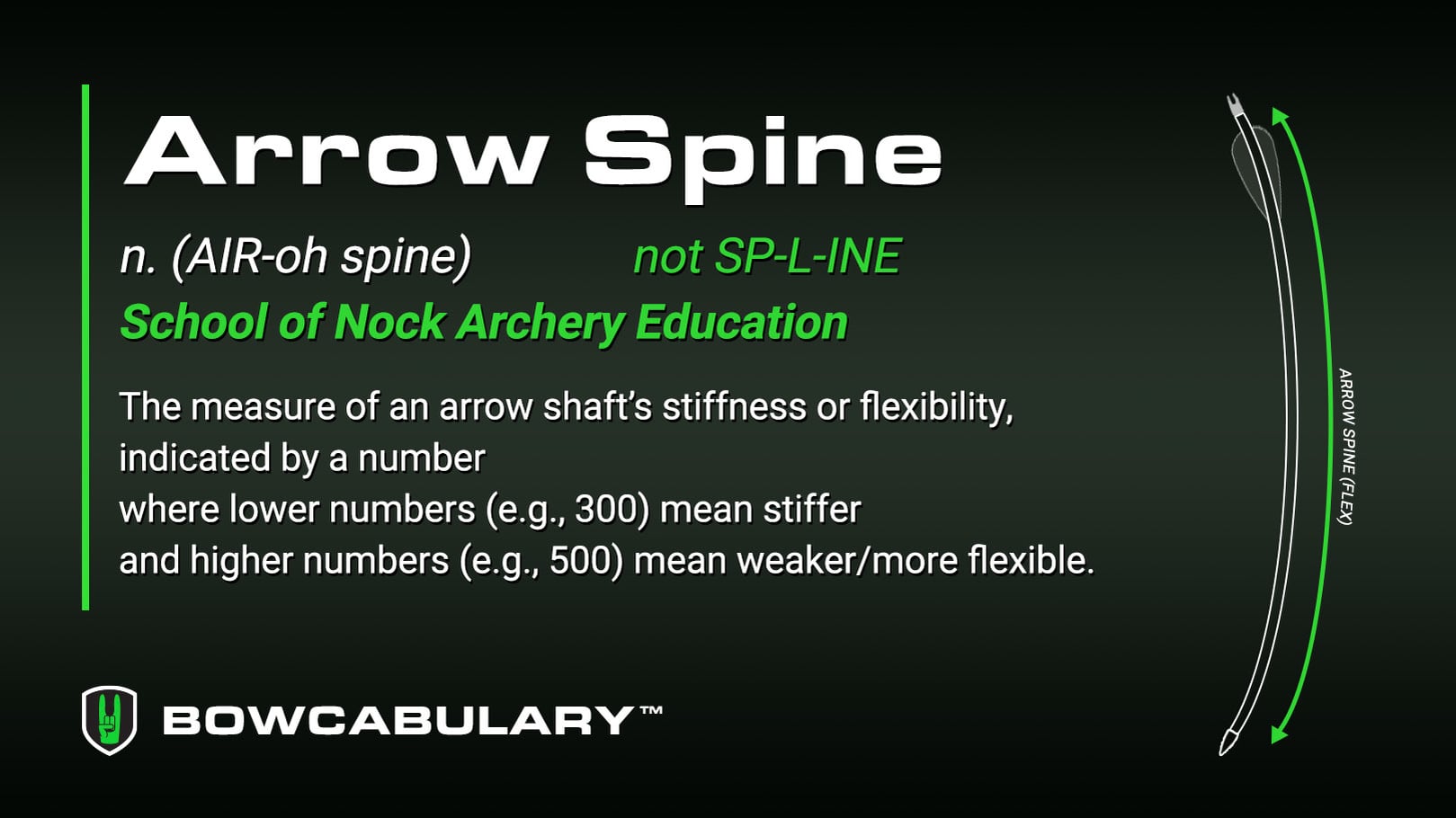
Spine measures an arrow shaft’s stiffness or flexibility. A number printed on the shaft indicates the spine rating: lower numbers (like 300) mean stiffer, while higher numbers (like 500) mean weaker and more flexible.
This distinction matters for accuracy. As the arrow leaves the bow, it must flex and bend correctly to fly straight. That bending behavior is called dynamic spine, and it’s influenced by your draw weight, draw length, and point weight.
How Spine Is Measured
Manufacturers determine spine using a spine deflection machine. The process is straightforward: support an arrow shaft at a 28-inch span, drop 880 grams of weight onto the center, and measure how much the shaft flexes. The flex measurement becomes the spine number.
You can buy one of these machines yourself, but you’ll probably use it once and never touch it again. Unless your shaft labels have worn off and you need to identify your arrows, trust the number the manufacturer laser-etched onto the shaft.
Matching Spine to Your Setup
Think of an arrow spine like your own spine carrying a loaded backpack.
If you’re hauling 100 pounds, you need a stiff, supportive frame. You’d best be solid to the core. But with 40 pounds? You can get away with almost anything, but a proper fit still performs better.
The pole vault analogy works, too. A lighter archer needs a pole that bends under their body weight to propel them over the bar. Hand that same archer a pole built for someone twice their size, and it won’t flex at all. Worse yet, if the person twice the weight tried the weaker pole, it could break. The vault fails.
Your bow applies the same principle. Higher draw weights and longer draw lengths generate more force, which requires a stiffer spine to handle the load. Lighter setups need a weaker spine so the arrow can flex properly on release.
Point weight also plays a role. More mass up front increases flex. Interestingly, weight added to the back of the arrow behaves differently because the string’s thrust absorbs it. More point weight means more flex, so the more you add, the stiffer you need to counteract it.
When Spine Matches Your Setup
Spine must match the forces your setup generates. Get it right, and you’ll see bullet holes through paper, tight groups on the target, and punched tags in the field.
One more note: It’s spine, not spline. No L.