
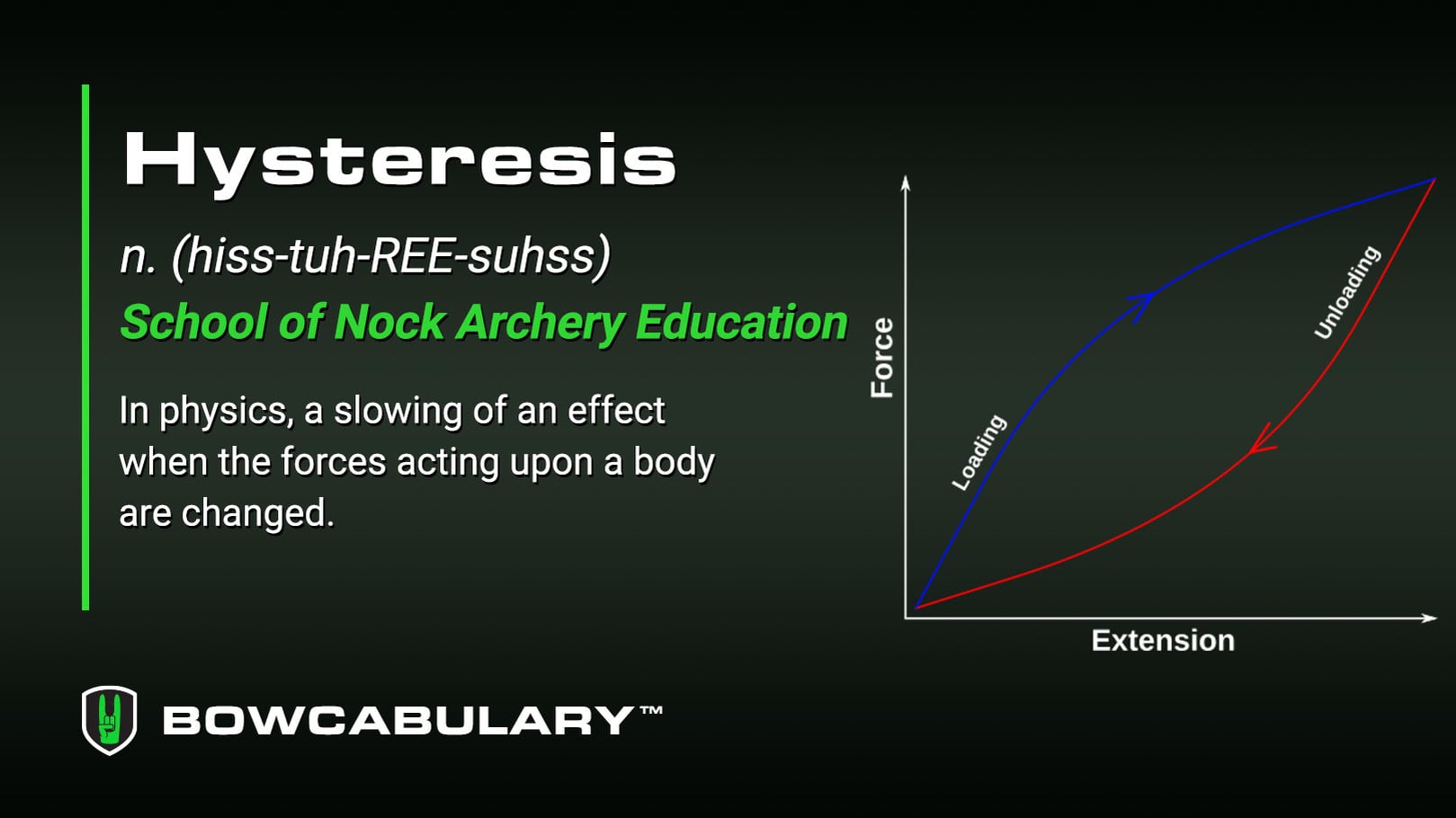
Hysteresis is the friction within all the operating components of your compound bow that influences its efficiency.
I first heard this term back in the late ’90s when bow companies were racing to improve let-off on their cam systems. Once I understood what hysteresis meant, I started noticing it everywhere in archery.
You can optimize your bow’s performance by understanding how friction works inside your setup.
How to Picture Hysteresis
Picture a pulley machine at the gym. If you’re sitting under the pulley and pulling the bar straight down, the cable rolls smoothly over the wheel with minimal friction.
Now picture pulling that cable down at an angle. The cable starts dragging across the wheel instead of rolling over it. Same weight on the pin, but it feels heavier.
That extra resistance is hysteresis.
Alternatively, think about motor oil in cold weather. If you’ve got too heavy of an oil weight and it’s zero degrees outside, your engine has to work harder to function. A lighter-weight oil flows more smoothly in that cold, and the engine runs with less resistance.
Same concept: reducing friction improves performance.
Where Hysteresis Shows Up in Your Bow
Your compound bow has friction points in several places, and each one affects how efficiently that bow performs.
Cables and Cable Management
Anywhere your cables move through a guide or over a surface, friction is at play. The closer those cables sit to a neutral position, the less drag they create.
Older cable rod systems with a cable slide are a prime example. You can feel the friction when you slide one back and forth. If you’ve ever gotten a cable slide wet on a hunt, you’ve felt that chatter, that hopping of the slide on the rod.
That’s hysteresis reducing your bow’s performance, and it’s why you start hitting low when your bow gets rained out.
Cam Spacers and Axle Fit
The spacers and washers between your cams and limbs affect how freely the cams rotate. If the axle is too tight, the cam struggles to spin. Too loose, and it wobbles.
When I worked in the bow industry, review bows got special attention before they shipped to editors. We’d sand spacers smooth, ream out the pressed-in bushings so the axle fit perfectly, and match serving diameters to the machined cam tracks.
Those small details made a measurable difference in performance.
Cam Lean
If one cam runs straight and the other has lean, you’ve got uneven friction in the system, similar to pulling that gym cable at an angle. If both cams lean in opposite directions, you’re compounding the drag.
String and Cable Thickness
If your string or cables are too thick for the cam track, they’ll struggle to move in and out of that groove. That friction adds up.
Limb Pocket Tightness
Some limb pockets squeeze the limbs together when you tighten the bolts. If they’re overtightened or if the pads aren’t fitting correctly, the cams can bind up instead of spinning freely.
What This Means for Your Setup
Every tuning change you make has a cause-and-effect impact on system friction. Shimming cams, adjusting yoke positions to change a tear, and replacing strings and cables can all add or subtract friction from your system.
If your replacement strings and cables don’t match the diameter specs the manufacturer machined their cams for, you’re introducing extra drag.
Bow companies are in a race toward the most efficient cam and bow system possible. But efficiency can’t hit 100%. When you pull back 70 pounds, some of that energy is lost to friction within the system. The goal is to minimize that loss.
Understanding hysteresis gives you a sharper eye for what’s happening inside your bow and why small changes can shift your performance. Keep your components matched to factory specs, keep friction points clean, and pay attention to how your bow feels when you draw it back.