

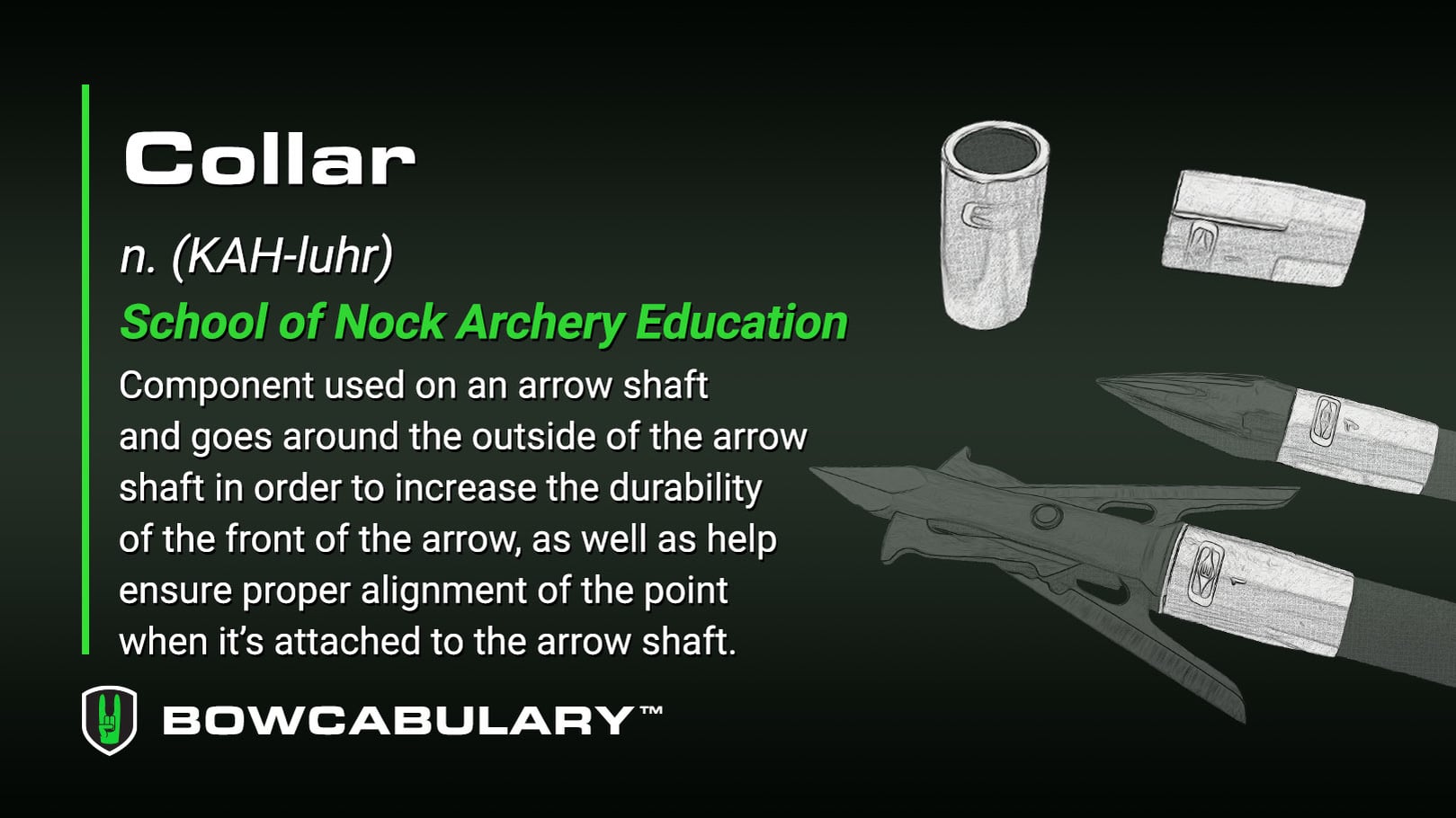
A collar is a small ring or sleeve that fits around the outside of an arrow shaft at the front. It has two jobs: reinforce the front of a carbon arrow for improved durability and help with proper alignment between the shaft, insert, and broadhead or field point.

Collars have been around for a long time. They were once common with traditional-style bows, disappeared for a stretch, and then came back into play in the early 2000s when the HIT (Hidden Insert Technology) came to the market. Their return has to do with smaller-diameter arrow shafts and the workaround for standard thread sizes in the tip of the arrow.
Why Collars Came Back
When Easton introduced 5mm and 4mm arrow shafts, the archery industry needed a new insert system. Traditional inserts butted up flush against the ends of larger-diameter shafts and provided ample internal clearance for the industry-standard 8/32-threaded points and broadhead ferrules. However, the smaller shafts couldn’t accommodate that design.
The solution was the HIT (Hidden Insert Technology) system. A HIT insert sits inside the arrow shaft rather than butting up against the end. A plunger tool inserts it so the insert is recessed, leaving room for the shank of the point to fit in the shaft while allowing the threads to tighten when you screw on a broadhead.
The HIT system exists for a reason: standard broadhead thread sizes have a fixed diameter. Since the arrow shafts got smaller to maximize penetration and minimize wind drift, those threads couldn’t fit inside the shaft wall anymore. Moving the threading internally and letting the broadhead ferrule sit inside the shaft solved that problem.
That internal insert created a new issue, though. With the broadhead ferrule fitting inside the shaft, certain areas of the carbon wall around the ferrule don’t have full support from the carbon wall. On hard impacts, the broadhead can tear through that unsupported section of carbon.
How Collars Solve the Problem
A collar slides over the outside of the arrow shaft and sits right over that vulnerable zone. Once you screw on your broadhead, you’ve got a coupling that wraps the outside of the shaft and overlaps the internal insert.


The result: maximum thickness and density from where the broadhead threads into the insert all the way to the tip. That added reinforcement greatly reduces the chance of the carbon tearing on impact.
A collar won’t make the shaft indestructible, but it certainly helps A LOT. Hit a rock hard enough, and it can still break behind the insert. But the front of the arrow, from the broadhead contact point through the end of the shaft and where the threads sit, stays intact.
Easton originally called their version the BAR or “broadhead adapter rings.” We included them with all the 5mm arrows we have in our store. However, other companies in the industry began making larger collars with greater coverage.
Easton decided to follow the trend, and today they offer match-grade collars that are larger in size, with specific shaft diameters and tighter tolerances for precise shaft-to-collar and collar-to-broadhead alignment. Nock On arrows that use HIT insert systems come standard with these new match-grade collars.
Pros and Cons
The Pros
Added durability is the big one!
Hunters benefit from the durability in the field, and the improved broadhead-to-shaft alignment is a big bonus. There are certain BIG GAME or DANGEROUS GAME hunts that have the potential for hitting extra heavy bone. Breaking through without breaking the shaft can mean tagging an animal or not. They’re great in hunting situations where you know there’s a chance of impacting a bone as hard as a rock.
In addition to hunting situations, these collars shine at 3D events, where a missed target can mean hitting rocks, stumps, or trees. Your field tip might bend, but the collar protects the front of the shaft and saves the arrow. It’s a big advantage when you miss and happen to find a hard object along the way. This can be a good option when a new archer is trying a TAC for the first time or is impacting a tree and needing to get it out.

Here’s an arrow that didn’t find foam or fur but is ready to be dusted off, and the arrow is still ready to go.
The Cons
Weird Weights
The new collars add weight, typically 15–20 grains. That’s an odd number that doesn’t pair neatly with standard point weights. That means you need to choose to have them all the time or not.
Sighting in with this odd weight number is critical, so you can’t just practice all summer without them and then install just prior to a hunt. After 30 yards, your sight tapes just won’t be on the money. If you add a collar for hunting season, you need to set aside time to sight it in.
The math isn’t cut-and-dry with collars. If you’re running a 100-grain point with a 50-grain insert and add a 17-grain collar, your total front weight lands at 167 grains. That means dialing in a sight tape that matches your exact total front weight at an odd number. Historically, we had inserts and points in 25-grain increments, which kept ballistics simple.
More Target Wear
Collars do a number on targets (bag targets in particular). The collar creates a lip that grabs the internal packing materials (cloth, netting, felt) on removal. This can be frustrating for the person pulling the arrow and for whoever owns that bag target.
Losing collars in foam targets is a constant problem. There are times when an archer may hit a hard spot in the target, and the impact breaks the collars and point free from the shaft. When you pull the arrow out, the shaft is saved, BUT it now remains lodged in the target, posing a hazard to the next archer who hits that spot. It’ll ruin most arrows hitting that spot as long as it’s inside the foam.
When to Use Collars
If you want added durability for 3D shooting, field hunting, or better broadhead alignment on smaller-diameter shafts, collars are worth adding to your setup. Keep the weight trade-off and target wear in mind, and consider swapping them on for specific situations rather than running them full-time if those downsides matter to you.
My Two Cents
I’ve been using 5MM all-carbon AXIS arrows since 2002. I don’t use collars 90% of the time. I completely trust the durability of the 5MM AXIS and FMJ without the collars, and I don’t recall a time when I didn’t have success as a hunter because of not having them on.
I view these as “added” strength, but I want to be clear that these arrows don’t lack strength without them. It’s like removing a factory bumper off a truck to put on an aftermarket reinforced bumper. The factory one is adequate and safe, but the aftermarket offers overkill just in case you hit something and want no chance of damaging the vehicle.
In my decades of hunting, sure, I’ve recovered arrows after an impact on an animal, and the front of the shaft was damaged either from passing through dense bone or from hitting a tree or rock after passing through. But in hundreds, if not thousands, of arrows in animals, they always do their job first.
Hunts are very costly in time and resources. I spend a lot of time preparing for them and don’t see why I’d hang all that on a used arrow that had hit something hard at some point but seemed fine because the collar saved it. I always have a quiver of new arrows and new broadheads on a hunt.
Collars extend the life of your arrows and boost your F.O.C., but be sure to consider the downsides of the decision. For me, the targets I practice on 99% of the year are the key factor.