

If I had my way, when you opened this post, it would come with Bruce Buffer’s voice: “Itttttt’s TIME!” No time is more exciting or full of anticipation than rutting whitetail season. Whitetails are the leader in excitement for the vast majority of North American hunters.
I’ve got no doubt you’re ready for the season from all the videos and newsletters we’ve hit you with. By now, you’ve put in all the prep. I bet your food plots are in, stands are hung, shooting lanes are clear, and that big tub of whitetail hunting gear is all organized and ready to get after it.
OK, maybe that tub of gear is still in complete disarray like mine is, but regardless, DEER SEASON 2026 is HERE!
I’ve been a deer hunter since I was nine years old and, humbly admit, have had plenty of success but only after many mistakes. Most of that success came in the last 20 years. I give the credit to learning a new formula for predicting my times to strike.
I’m a big believer in timing over time spent. I’ve proven to myself that shooting mature bucks comes with the strategic experience of hunting less, not more. Animals change their patterns and their exposure to daylight more from increased human pressure than anything else.
If you’re leaving an imprint on their environment, they’ll soon form a new pattern that avoids it. Educated whitetails can pattern you, the same way you can pattern them. The purpose of this post is to tell you when I’m going to pick my times to be in the saddle.
Understanding the Moon

I credit a large part of my success to a great friend I met on a whitetail trip in Montana, Gary Clancy. Gary was an amazing Midwestern outdoor writer and took pride in writing every bit of his outdoor experience in a journal since he was a kid. He saved them all: decades of daily notes, citing everything.
He described his findings on animal movements based on weather, days of the month, and the moon. Then he told me one of the simplest observations of all, which completely changed my efficiency.
The “Minor” is when the moon is 90 degrees to us on either side of the horizon. Think of it like dusk and dawn. The “Major” is when the moon is directly overhead or underneath us.
Gary gave me the simple task of hunting during times the moon was rising on the horizon or coming down on the horizon: the two hours as the minor appeared or the hours as it fell. He didn’t think it mattered what time of day it was, meaning it could be at 9 a.m. or at 8 p.m. Whenever that was, that’s when you could predict better movement of animals.
Many people think the “Major” time is when the most movement occurs, because of its name. Gary respected me as a hunter and urged me to test his historical documentation.
He was a great hunter with a lifetime of documentation, a well-known writer, and an even better fisherman. His dedication to notes showed me a new path to success in the field, and he’s truly missed.

I came across an amazing statistic from fisheries scientist Ralph Manns, who conducted a massive study on the moon’s effects on bass fishing: 2,500 trips totaling 10,466 hours. The highest catch rates occurred on the Minor phase, at the start of the minor on the horizon and then again just before the fall of the minor later in the day. The lowest catch rates came in the hours just before both the major and minor.
This year, the moon was begging to come up as the sun was setting, a full week before Halloween. Buck sightings surged, and people on social were saying “it’s going to be an early rut.” Yet here we are approaching Halloween, and the sightings have already slowed during the evening sits.
My understanding of the moon points directly toward this. The good news: this full moon will be fading right as the real rut gets underway.
I predict an amazing mid-November in the Midwest compared to previous years, where the full moon was hitting right at the lockdown phase. If you track historical data alongside moon phases, the pattern becomes hard to ignore.
Other Key Factors
Aside from the moon, let’s set some other elements for successful hunting on the table. The season has phases that are “good,” but lulls fall in between them. I don’t like hunting without purpose.

I use lulls for hunting unknown areas to prevent burning out my hot spots that can produce when conditions are right. If it’s mid-October and it’s a notable lull, use it for recon vs. burnout. Try somewhere new and hope for a fluke.
The good times break down into three phases: Early, Rut, and Late.
1. For the typical whitetail season, the early phase can be amazing. If you gather your intel, this can be a great time to arrow a big buck on a pattern to a food source. You’ve got a few days to strike before the word gets out in the woods that hunters are back on the prowl.
Pressure is quickly felt, and early patterns will change fast. Be precise and do your due diligence with your Stealth Camera on when to be there. Bucks are patternable, but don’t forget, they’re still reactive.
A seven-year-old buck may only need evidence of you in his area one time before he goes completely nocturnal. Don’t get antsy checking your game cams too much. If possible, conduct your surveillance from a distance, preferably during natural agricultural traffic.
When I do early-season surveillance, I only check my cameras when the tractor is there: mowing, planting, or harvesting. If you don’t have common farm equipment to mask your imprint, pick really windy or bad-weather days to do it, when game is hunkering down.

- The Rut. For most, this is their favorite time of year. The biggest bucks on the planet lose their minds, and yearlong nightwalkers let their ladies get them in serious trouble.
Bucks are responsive to rattling and calling and can be on their feet all day long. The Rut has three phases: the Pre-Rut, Peak-Rut, and Post-Rut. My longtime friend Bill Winke has priceless information on his website about rut phases, so check it out.
The pre-rut is when bucks often reappear from the lull to mark their territory, scent-mark, and check females. Frequently, that’s on or near food sources where does are concentrated. They let their guard down to take inventory of other bucks, claim dominance, and know which doe may be ready for breeding first.
Oh yeah, baby! Now is the peak rut. Bucks have one thing on their mind, and all wild cards are on the table.
Food sources aren’t my preference for hunting locations because the doe scatter from open areas and head to thickets where they can elude raging bucks. That’s the one time when I’m in my best spots, and I’m there ALL DAY. Pack your breakfast, lunch, and dinner, get to the areas with good cover, and wait for your shot.
Post-rut bucks are cruising and covering ground, looking for any doe that may still need to be bred. They’ll be moving in travel corridors, thickets, riverbeds, and big timber. They’ll make evening appearances again on food sources, needing to recharge after that first rut phase but still checking does in hopes of finding one more to breed.
- The late season. All breeding has concluded, and the pressure of the gun seasons is over or near an end. The late season can be great, and the weather has a big effect.
Foul conditions will bring heavier movement, but mild conditions leave you positioned for strategic hunting choices. Find food sources and find bedding, then plan your hunts according to which of those areas you have to hunt.
If your spot has food, hunt when deer movement is highest. If you don’t have a food source for late season but instead only offer bedding, you’ve still got an opportunity to use the formula I’m about to expand on.
The Wild Card

One of the wild cards that sometimes plays into my hunting choices is the weather. Mother Nature likes to do as she pleases, and sometimes it’s just enough to either disrupt a plan or escalate it.
Cool evenings during the early season or frigid cold during a late-season food-source hunt can really help you pattern a buck and punch your tag. High heat, high winds, or heavy rain can slow the movement even if the time is right. But you can still use all three to your advantage.
High heat means animals need water. Where can you find a water source, and can you be there during peak movement?
High wind isn’t a great time to be hunting, but movement will be lower at that time, so it’ll be higher immediately afterward. Planning a hunt after several days of low movements from high winds can be a smart move. I always plan to have some spots specifically for high-wind days: as far out of the wind as possible, with good cover and rut potential.
High winds don’t pause the rut, but they slow it, and having a “windy” location in your pocket is a great wild card.
I personally don’t mind rain, but a full-on downpour is low on odds. When bucks are marking territory, they’ll reapply their scent after heavy rains. Be in the areas where you’ve found scrapes, lick branches, and rubs.
Can weather be frustrating? YES. Can you still use it to your advantage? YES.
Connecting the Dots

Let’s get down to the nuts and bolts of this post. When is the best time for you to be in the woods?
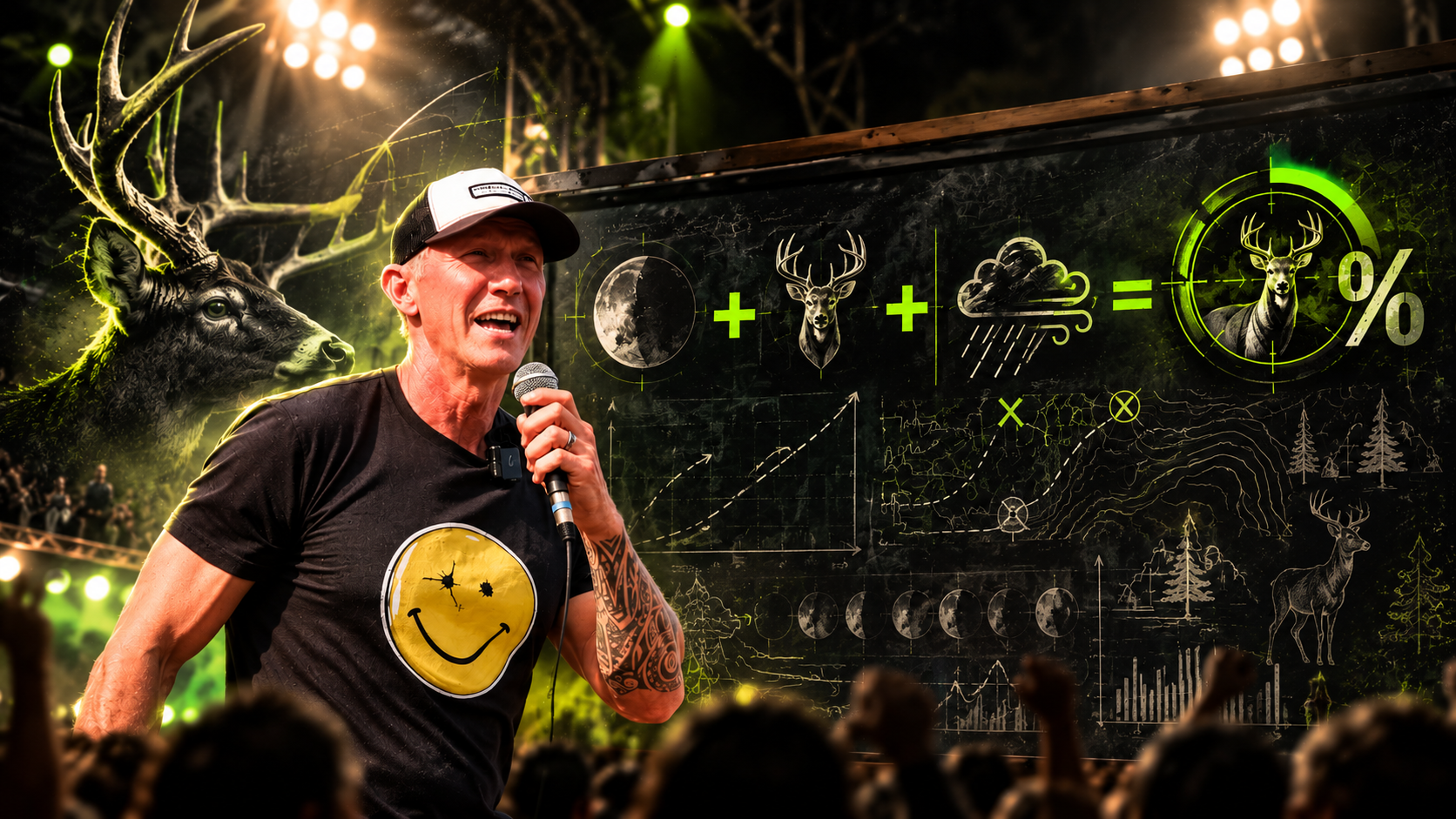
A good teacher explains and helps you become self-sufficient in solving problems. I’ve given you all the elements of the equation I work out every hunt throughout the fall:
Moon Phase + Hunting Phase + Weather = Opportunity %
Look at the moon phase and find the times when the moon is at its key phases. Then look at your hunting phase and decide where the best place for you to be is during that time. Factor in the weather and how it could favor your situation and hunting spot.
Add it together, and you’ll see a percentage of how effective your hunt will be.
My favorite days for evening hunts are on the days before the full moon each month, when the moon is rising on the horizon as the sun is setting on the other. I love it when the moon is coming up during daylight or setting during daylight. Add those times in with the hunting phase.
The rising moon was October 21–23. These were key days to be on food sources with doe concentrations, especially if you have a buck patterned.
Shifting forward, I’d focus on the times later next week when the moon is falling during the day. Get in the right spot. Bucks are in pre-rut, marking areas and responding to some morning calling.
In November this year, the full moon isn’t until November 24th, which is awesome. We normally have full moons earlier in the month, so that’s a big advantage. Nighttime movement will be less during the first three weeks of the Rut.
Add that to the days with good weather, and you can build a plan around multiple stand locations on a magnitude of days. If we get a heat wave, hang in there and take advantage of November finally having a late-month full moon.
In December, the late-season food and bedding sources can be super productive. The best evening feeding days regarding the moon will be December 19-21. As that full moon peaks on December 23rd, the bedding areas can produce if you hit it when the moon is falling.
If you’ve got nasty weather in the late season, be out there on the front end of it. Movement will happen.
We all have limited time for hunting, whether it’s work, family, or other commitments. Learning to hunt when your odds are the highest is the difference between punching a tag and going home empty. Each region of the United States is slightly different in peak timing.
In the past, I tried giving you exact days, and for me in the Midwest, those times proved fatal for the bucks on my hit list. Two states south, the timing could be slightly different. Understand what I weigh when I decide on my plan of attack, and you’ll be able to adjust this prediction for your area.
Moon Phase + Hunting Phase + Weather = Opportunity.
I’m certain if you follow the formula, you’ll be able to make your own predictions about success. Good luck!
Sidebar: Several awesome phone apps track moon phase times. Combine one with a weather app and your game camera intel, and you’ll have an amazing window to strike.