
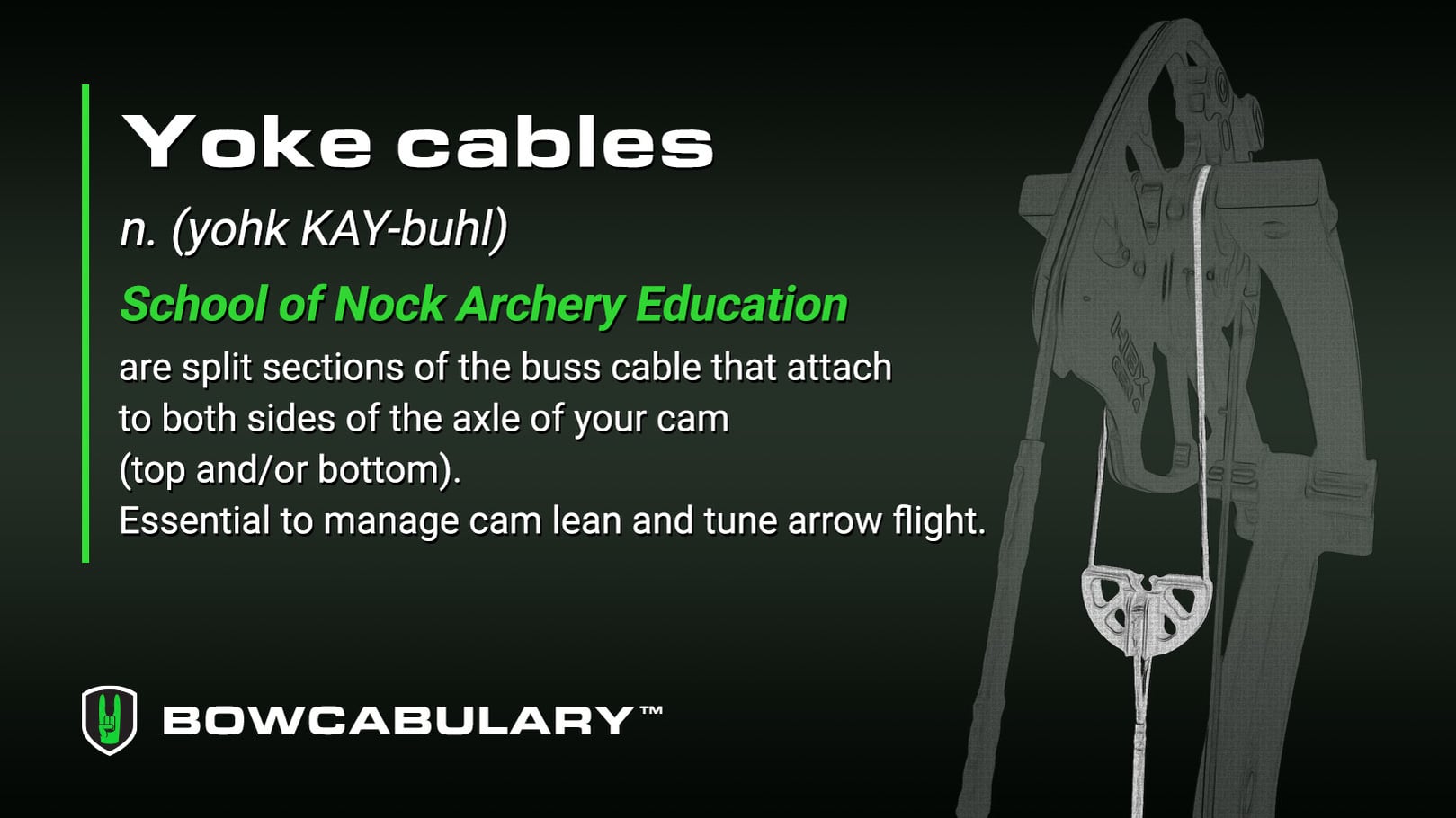
A yoke cable is the split section of the buss cable that attaches to both sides of your cam’s axle. Depending on the bow model, it can run to the top cam, the bottom cam, both, or neither.
Its job is to help you adjust cam lean and tune your arrow flight. By twisting one side of the yoke or the other, you shorten one leg of the split, which levels up the cam and limbs. Get the cam dialed in level, and your arrow flight cleans up.

The name makes sense when you picture it. Think of the Y in the letter, which mirrors the shape of the cable splitting from one strand into two.

How Yoke Systems Have Evolved Across Brands
Yoke systems have changed over the years. The older bows ran a regular split yoke right out to the outside of the limbs. You twisted one side or the other to balance the cam.
On those older bows with cable rods pulling the cables over, the outside had more pull on it. You’d shorten the inside leg, closest to the cable, to level out the cam.

Hoyt then introduced a floating yoke system that didn’t split the same way. It had one piece running through another piece, and it stayed popular for a stretch.
Some cam designs dropped the yoke. Those bows ran control and power cables with no yoke involved.
Tuning a no-yoke bow took more steps. If your cam showed any lean, you might have to flip a heavier limb to the other side or fine-tune your spacer positioning. A lot of the time, you were stuck with how balanced the limbs were on the system.
Different yoke systems carry patents and IP, so not every company can run the same design. PSE used a design that crossed over through a small bracket. They called it the PBTS system.

Hoyt’s new yoke system is straightforward. It has a small piece you can adjust on either side. Most newer setups need little adjustment, and you’re only touching the top yoke if a tuning issue pops up.

Mathews runs a different setup. Their yoke wraps around the cam itself, not attached to a post like other systems. It’s still a Y configuration, and they’ve reworked it many times over the years.

Tuning Cam Lean With or Without a Yoke
Tuning out left and right tears often comes down to manipulating those yoke twists and changing the cam position.
Hoyt’s new XTS system on the limb pockets gets you the same cam adjustments without needing to touch the yoke.

How the Yoke Fits With Your Other Cables
One quick clarification on the cables themselves: The buss cable, sometimes called the power cable, has traditionally carried the yoke. The control cable is the non-yoke cable, and then you have your string.