


Most bowhunters I talk to would rather be in a tree stand than standing in an indoor range putting holes in paper. I get it. I used to feel the same way.
But here’s what two decades of competitive archery and bowhunting have taught me: The skills you build under those fluorescent lights translate to arrow placement when it matters most on foam or fur.
Indoor target practice is a proving ground where you eliminate variables, build consistency, and develop the kind of subconscious shot execution that holds up when a mature buck steps into range. The controlled environment strips away excuses and forces you to confront your form, your equipment, and your mental game head-on.
This blog post breaks down why indoor practice matters, shares some pro-level tips for getting more out of every session, and gives you a practical framework for tracking your progress throughout the year.
The Connection Between Target Archery and Bowhunting Success
Being a target archer made me a better bowhunter. Target archery forced me to refine every aspect of my shot process in ways casual backyard practice never would. It also put me around people who added pressure on me to BE GOOD in the TOUGHER MOMENTS.
When you’re shooting at a Vegas-style three-spot target, there’s nowhere to hide. You’re in a three-inch space sandwiched between archers spanning the floor. Your space is no larger than a tree stand. That yellow center ring is small, at the end of the hall, just like a tight lane leading through the trees to the vitals.
Your arrows either go there or they don’t. The feedback is immediate and honest. Just like in bowhunting.
But in indoor archery, you eliminate the variables of bowhunting, and all that matters is your shot execution! You’re either in control or not, and that’s what I love about this perspective and why it matters so much.
You can’t blame the wind, the terrain, or a branch that deflected your shot. It’s you, your bow, and the target.
This kind of focused practice builds three skills:
- A consistent shot process that’s automatic under pressure
- Refined aiming discipline that transfers to real hunting scenarios
- Mental resilience when shots don’t go where you planned
Billie Jean King said it best: “Champions keep playing until they get it right.” You don’t have to chase a world title. You have to CHASE THE PROCESS to perfection.
That mentality separates archers who plateau from those who keep improving year after year.
Pro Tips for Getting More Out of Every Indoor Session
Indoor ranges give you one advantage you can’t replicate anywhere else: complete control over your shooting environment. Consistent lighting, level ground, no wind variables.
This controlled setting lets you isolate what’s actually happening with your form and equipment.
Creating Better Aiming Points
One challenge I hear about constantly, especially from hunters my age, is that traditional paper targets start to wash out. The rings blur together, and finding a precise aiming point becomes frustrating.
When you shoot your arrow into the target, you’re allowed to mark the hole, and you should! Most people make a small tick mark with a pencil. Instead, use a bigger marker and mark it with the tick closest to the middle. This creates a bolder black dot right in the center of the yellow as your round goes on.
Throughout the round, you’re building what we call a “suck hole,” which is a dark, high-contrast aiming point that’s easy to see and impossible to miss. You can hear it when an arrow slides into one of those enlarged holes. It sounds like it’s passing through a cave before hitting the backstop. That’s the kind of crisp feedback loop that builds confidence.
On the flip side, if you send an arrow out of the middle and don’t make a mark, slide your arrow behind the target and seal the hole shut. It may not seem like much, but when you’re on the shooting line, this lets you see a big arrow hole in the middle of the gold instead of a target that looks like you sprayed it with a turkey choke. Mentally, it builds comfort to see a tight group rather than a paper filled with holes off the mark.
The Value of League Shooting
Getting active in an indoor league makes a huge difference. The competition helps, but the real benefit is accountability. Knowing you’re going to show up every week forces you to maintain your practice schedule when motivation dips.
League shooting puts you on the line with other archers at different skill levels. You’ll pick up techniques, see different equipment setups, and push yourself in ways solo practice can’t match.
Break Through Barriers With a Bestie
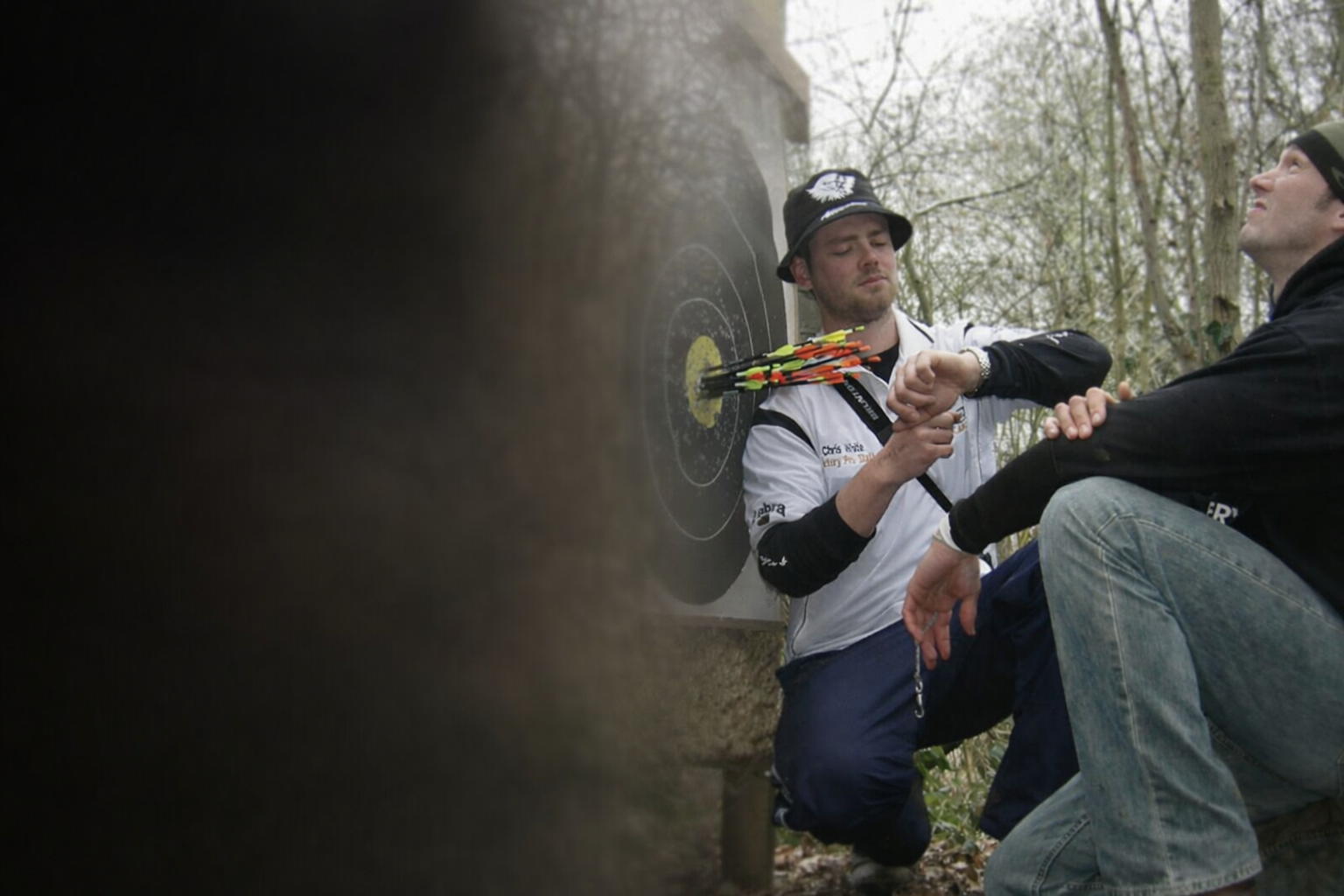
Croatia, 2004. I was toe-to-toe with Chris White from Great Britain in the gold medal match. Chris is a lefty, so we were eye-to-eye on every single target. It was a dogfight that came down to the last target.
It was my first time in that scenario for the World Field Competition. USA vs. UK, with one target to go. Sixty meters is a gold spot surrounded by a crowd of people and the balconies of the host hotel, lined with competitors from other countries.
I was nervous and underprepared. Chris wasn’t. He had been there before and had the experience required to win.
Fast forward to the month leading up to the next World Field Championship in Sweden. What did I do for training? I called Chris White and asked to train with the person I needed to raise my game to. Chris knew we would push each other in great ways. He agreed with open arms, and I left my home range and flew to England.
I remember training with Chris so vividly. Chris is one of the best archers I’ve ever shot with, in or out of competition. He was not a rival, as some had seen us. Instead, he became a bestie who pushed me to be better and shape my abilities even today.
During that training week, we decided to see how many ends we could shoot before someone missed the center. It was epic! We were pulling for each other to hit, not miss! End after end, we both kept putting arrows exactly where they needed to go. “Okay, bro, you got this. Put it in there!”
We eventually walked off that course without either of us dropping a single shot. At the Worlds, we were on the same targets for most of the event, and it felt like that week. It came down to the semifinals for one of us to make it to the medals. This time it was me.
That experience reinforced one idea I’ve never forgotten: High-level performance comes from stacking so many quality repetitions that excellence becomes your baseline.
Champions keep playing until they get it right. We were playing until one of us got it wrong, but the reality was that both of us kept executing. That’s what happens when you eliminate placebos, stop changing your equipment constantly, and commit to the process.
Finding What Works and Sticking With It
Too many archers chase equipment changes instead of putting in reps. They swap sights, change arrows, adjust draw length, and tinker with stabilizer weights, all in search of some mechanical advantage that’ll make them shoot better.
Find what works for you and then stop changing it.
Then put in the work. You won’t find shortcuts around repetition.
Tracking Your Progress
Get yourself an arrow clicker (they’re cheap on Amazon) and keep track of every end you shoot this year. Mount it on your quiver and click it after every set of arrows. Each click adds another notch in your belt toward becoming a better archer.
This simple tracking method gives you concrete data on your practice volume and creates a psychological commitment.
When you see those numbers climbing, you won’t want to break your momentum, and you’re less likely to skip sessions.
Breaking Through the Plateau
I hated these indoor targets for a long time. The Vegas three-spot intimidated me, and overcoming that mental hurdle took longer than I’d like to admit.
But person after person eventually breaks through, and once you do, your whole approach will change.
It’s like a runner chasing a pace they’ve never hit before. You stay with someone faster, matching their stride when it feels impossible, and suddenly you cross the finish line at a time you never thought you’d reach.
From that moment on, you know it’s possible. You’ve done it. The belief goes from theoretical to proven.
Indoor practice builds physical skill and the unshakable confidence that comes from knowing you’ve put in the work when no one was watching.
Get to the range. Eliminate the distractions. Start pounding paper.
The skills you build there will show up when you’re at full draw on a November morning, watching a buck work toward your setup. That’s when all those indoor reps pay dividends.
Your shot breaks clean, and your arrow finds its mark. Your body knows exactly what to do.
You can do this. I know you can.

John Dudley is a lifesaver.Ever one of his lessons are spot on. Read follow and you will get better. Not a pro, but a heck of a lot better than I was before finding out about Nock On Archery