

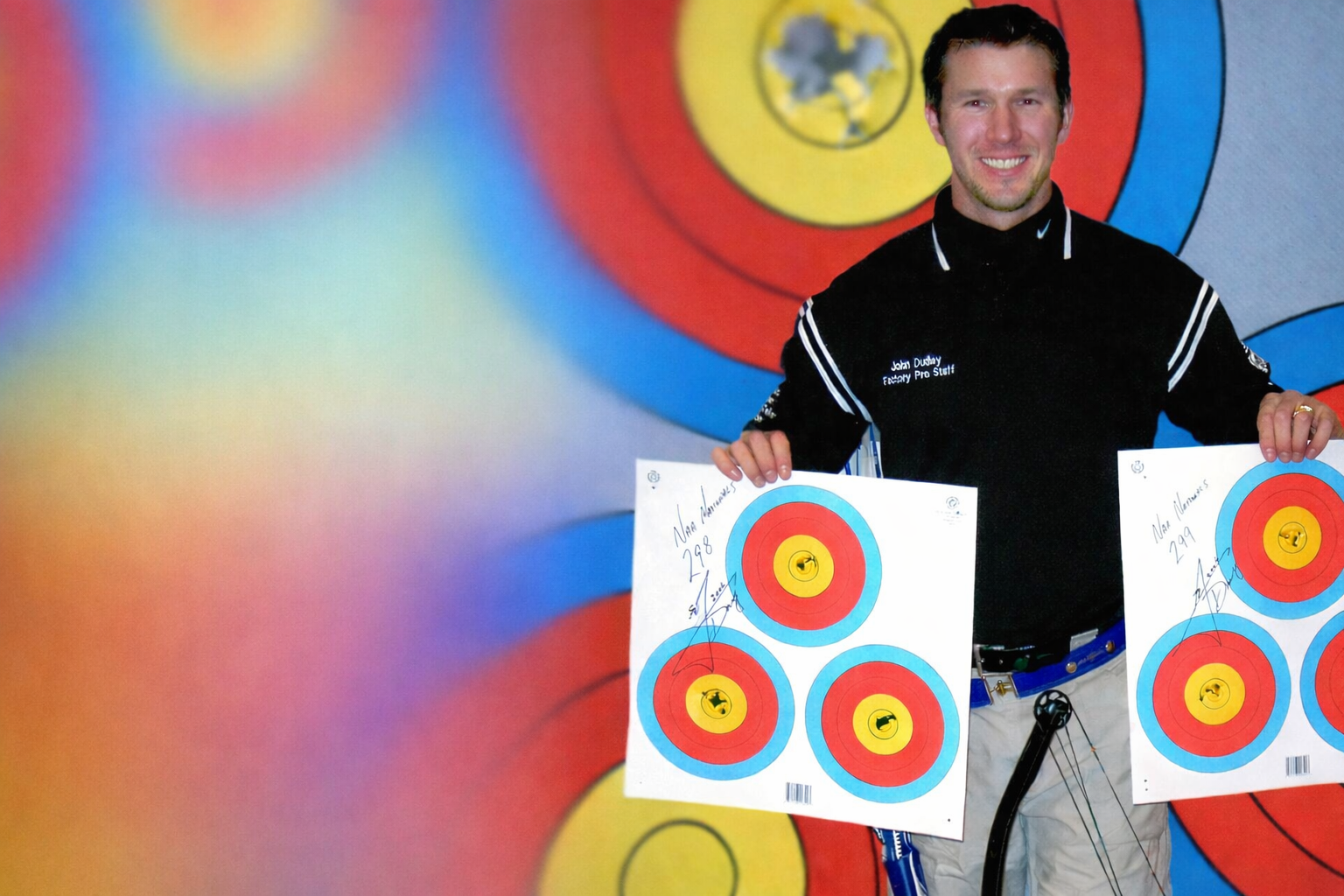
Most archers chasing a perfect 300 score focus entirely on execution: draw cycle, anchor point, release. Most look for the next scope, release, target model bow, or complex stabilizer setup. They overlook the strategic decisions that happen before they ever nock an arrow.
After years of professional competition and coaching thousands of archers through my School of Nock, I’ve identified four adjustments that consistently help shooters break through to their first perfect round.
I was a professional 3D shooter with titles under my belt when I decided to try indoor paper targets. The result was embarrassing.
But I became a 300 shooter by applying these same principles I’m about to share with you. These aren’t theoretical concepts. They’re field-tested solutions to the exact problems keeping most archers stuck in the 290s.
Remember: Success is the sum of small efforts, repeated day in and day out. If you want to be a 300 shooter, you need to learn to pick up that bow cold and put the first arrow where it needs to go. Then do it again for every arrow through the last shot of the round.
Continual short practice sessions will help you be able to pick up and go instead of trying to remember all the things you were doing well a week ago at practice. That consistency only comes through intelligent, focused practice each day, whether on a range or even in a basement.
If you are ready to put in the commitment, here are the four things that will really make a difference!
Recognize the Colors That Give You Trouble
Your target face color might be sabotaging your scores without you realizing it. As a 3D shooter, I spent years aiming at black, brown, and tan foam targets. The only paper I shot was paper plates on hay bales before hunting season.
When I started shooting Vegas faces with their bright yellow, red, and blue rings, my pin looked like it was dancing all over the place or washing out in the colors. The NFAA five-spot, with its white-and-blue combination, created the same type of problem.
The issue isn’t your form or your equipment. It’s how your eyes process certain color combinations against your aiming aperture.
Some archers struggle with high-contrast targets, and others have difficulty with muted tones. You won’t know which category you fall into until you experiment.
I pushed through my color struggles by finding target faces with identical scoring ring sizes and proportions but different color schemes. That’s exactly why my self-healing targets use green and black. Those neutral colors don’t create the same visual conflict bright yellows caused for me.
Before you assume you have an aiming problem, try the same target in a different color combination. You might find your “bad shooting days” correlate to specific target faces.
Lower Your Poundage for Quality Repetitions
Every archer shooting consistent 300s at serious competitions has made a deliberate choice about draw weight. They’re shooting 60 pounds or less, almost without exception. They’ve likely switched to a smaller peep, added a lens to their scope, and modified their aiming aperture.
But the poundage reduction is the foundation that makes the rest of the system work.
Higher draw weight creates cumulative fatigue that shows up in your later ends. I was practicing recently on a five-spot face, shooting my hunting poundage, and dropped one into the outer ring on one of the bottom targets. That’s the equivalent of missing a 5 on an NFAA face, and it cost me the 300.
Those closing ends demand the same precision as your opening shots, but your muscles are working harder to maintain it.
The fatigue pattern typically looks like this:
- Arrows 1–15: Tight groups, minimal float
- Arrows 16–24: Slightly larger hold pattern, occasional drift
- Arrows 25–30: Noticeable muscle tension, or shoulder collapse, or increased movement during aim
When you’re shooting hunting weight, you’re working against basic physiology. Lower poundage lets you manage the bow easily from first arrow to last.
Plan on adjusting your arrow setup to match. Most serious indoor shooters move to larger-diameter shafts, which offer more stability and better line-grabbing potential when a shot drifts slightly off center.
I’m not being hypercritical about my own late-round arrows right now since I’m deliberately practicing with hunting setups. But if you’re chasing that first 300, drop the ego about poundage. The number on your limbs doesn’t appear on the scorecard.
Match Your Aiming Aperture to Your Sight Picture
Your pin size and color can make or break your indoor scores, and the solution isn’t always what you’d expect.
I’ve had seasons where I needed the smallest possible aiming aperture, literally placing my pin inside the holes I’d already shot in an X-ring. In other years, I succeeded with a dot so large it covered the entire yellow, turning my sight picture into one blob rather than a precise point.
The “aim small, miss small” philosophy doesn’t work for everyone. For me and my particular sight picture, that approach has been a nemesis at times.
When you use a tiny pin on a small target, you see every micro-movement your bow makes during the aiming process. Some archers handle that information well. Others, myself included in certain seasons, shoot better when they can’t see how much they’re moving.
Consider these aperture variables:
- Pin size relative to your target’s scoring rings
- Color contrast between your pin and the target face
- Whether movement visibility helps or hurts your mental game
A red pin on a yellow-and-red Vegas face creates visual confusion for me. That’s why my top pins are always green. Bright green works against the dull green of my practice targets, shows clearly in the black center rings, and doesn’t compete with standard competition colors.
If you’re struggling to aim on paper targets, the problem might not be your steadiness. Try going bigger with your dot before going smaller. Try different colors before blaming your form.
These equipment adjustments cost almost nothing compared to the frustration of plateauing below your goal.
Start Close and Walk Back to Your First 300
Mental pressure kills more 300 attempts than physical errors.
You know the feeling: three arrows left, shooting clean, and suddenly your bow feels heavier and your pin won’t settle. It’s not your ability to shoot the 300; it’s the belief that you are a 300 shooter that’s holding you back. The walk-back method eliminates this pressure by making perfect scores routine before you ever face them at full distance.
A coach taught me this approach, and my first 300 came at 15 yards using this exact progression. The program runs five to six weeks and works like this:
- Set up at 15 yards and shoot full rounds until you can consistently score 300.
- Once you’ve achieved a week of consistent 300s at that distance, move back exactly one yard.
- Repeat the process at each new distance.
- Continue until you reach 20 yards.
The magic happens in your subconscious. By the time you reach full distance, you’ve shot dozens of perfect rounds and it’s not the score your mind is worrying about; it’s just the reps. You’ve experienced the last three arrows of a clean game so many times that the pressure dissolves.
You stop worrying about flubbing the final end. You’ve proven to yourself, repeatedly, that you finish rounds clean.
It took me about six weeks to work from 15 to 20 yards. Somewhere in that process, I stopped noticing when I was shooting 300s. The score became expected rather than hoped for.
Only after I had total confidence in the 300 did I start chasing X counts.
Building Your Path to Perfect Scores
Indoor shooting strips away the variables complicating outdoor archery: wind, terrain, distance estimation, changing light. What remains is pure execution repeated 30 or 60 times. That simplicity makes indoor ranges the ideal place to solidify your shot process and build genuine confidence in your abilities.
The four adjustments work together as a system. Finding target colors that don’t fight your visual processing lets you aim with confidence. Lowering poundage means your 30th arrow feels like your first.
Matching your aperture to your natural sight picture removes unnecessary mental load. And the walk-back progression builds the psychological foundation that turns 300s from achievements into expectations.
These aren’t shortcuts; they’re intelligent applications of the principle that success comes from small, consistent efforts. You’re not bypassing the work. You’re directing your work toward solutions that actually address why archers miss, rather than practicing the same problems at higher volume.
Start with an honest assessment of where your scores break down. If you’re losing points early, look at colors and aperture.
If you’re clean through 20 arrows and then scatter your final end, poundage is likely your issue. If you shoot well in practice but fall apart when scores count, the walk-back method will rebuild your mental game from the ground up.
The path to your first 300 isn’t mysterious. It’s methodical, patient, and entirely achievable with the right approach.