
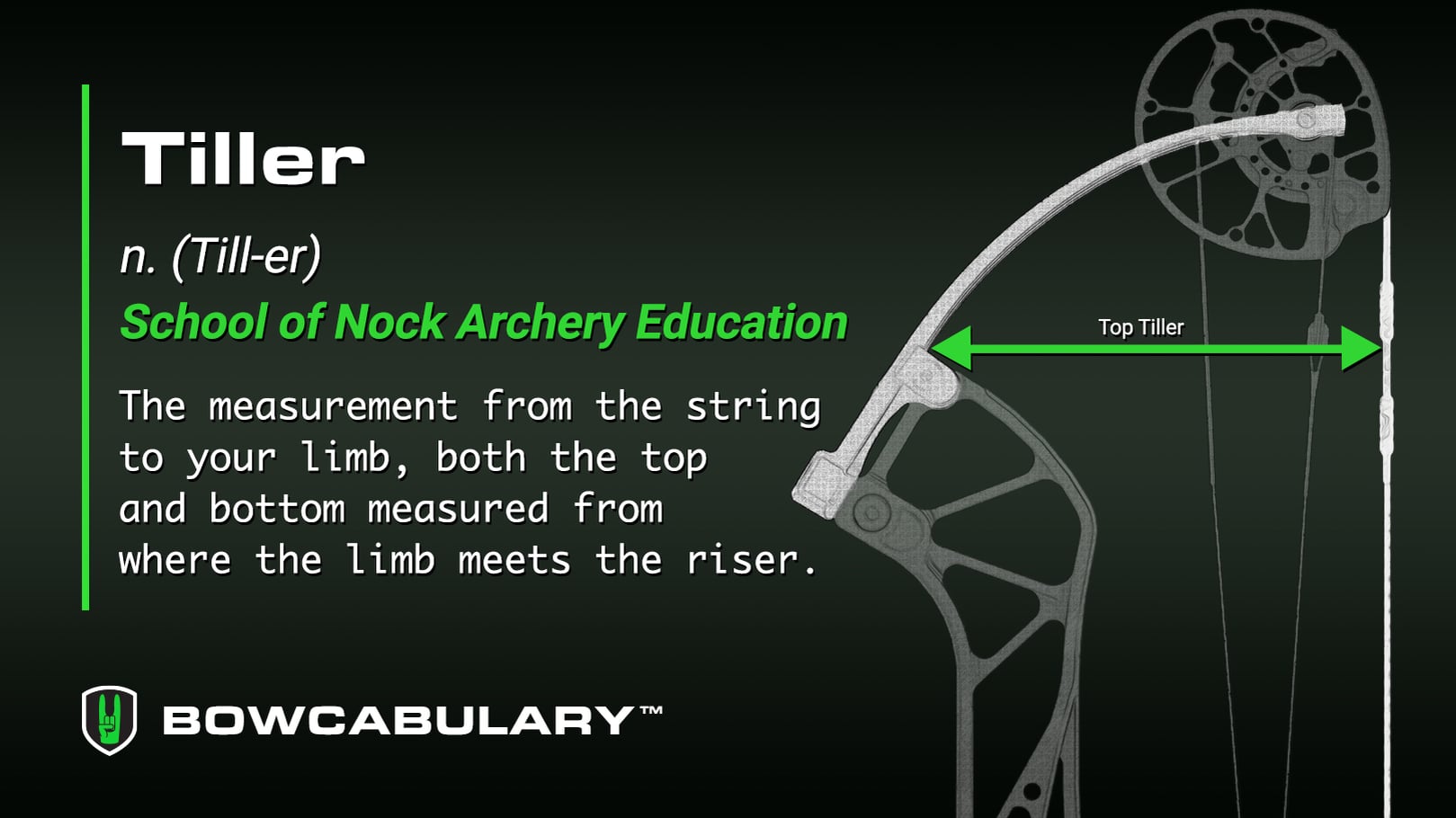
Tiller is the measurement from the bowstring to the limb, taken at the point where the limb meets the riser, on both the top and bottom limbs.
You can grab this measurement with a bow square, and it tells you a lot about what’s going on with your setup.
How to Measure Tiller
Place your bow square where the limb meets the riser and measure straight up to the string. Do this on both the top and bottom limbs.
If the two numbers match, you have even tiller. If one side is longer or shorter, you have positive or negative tiller depending on the direction it goes.
Why Tiller Mattered More in the Old Days
Tiller tuning used to be a much bigger deal. On recurves and traditional bows, limbs were made in separate presses using wood, epoxy, and fiberglass.
Those limbs didn’t always come out perfectly balanced, so archers would adjust tiller to get the bow to aim, balance, and tune properly. Especially with takedown recurves, where the bow gets disassembled for travel, tiller bolts could shift. Archers had to check their measurements every time they strung the bow back up.
Modern Limb Manufacturing Changed the Game
Today’s compound bow limbs are cut from the same plate of glass using a water jet, then run through a planing machine and a deflection machine that measures the flex of each limb on a digital graph. All four limbs on a modern compound bow are basically quadruplets. The deflection numbers match so closely that you’re no longer adjusting tiller to balance uneven limbs.
For example, on a Hoyt, all four limbs come from the same piece of material. The numbers on each limb match. So tiller tuning to balance limb flex isn’t really a factor anymore.
What Tiller Adjustments Still Affect
Even with better-built limbs, adjusting your tiller bolts still changes a few factors on your bow.
Nock position. If you’re not making even adjustments to the top and bottom limb bolts, your nock point will move up or down. However, back out the top limb, and the nock point drops. Tighten it, and it rises. The opposite is true on the bottom limb. This means you can fine-tune your nock position or correct a high or low tear through paper by adjusting tiller on one side without moving your rest.
Draw length. As you back out the limb bolts and reduce poundage, your tiller measurement increases, and so does your draw length. Some archers find a better hold or a more comfortable aim at a specific tiller setting, and that’s often tied to small changes in draw length.
Bow hold and aim. Micro-adjusting your tiller bolts can change how the bow feels at full draw and how it holds on target. This is because you are moving the nocking point up or down in relation to where you hold the bow in the handle. It creates a different balance of the triangle. That’s why you may hear some archers saying they get their bow to aim better with the nocking point closer to the handle or higher from the handle. With today’s limb technologies, it’s a fine-tuning tool, not a fix for mismatched limbs.
The Simple Rule to Keep in Mind
Backing out a limb bolt reduces poundage and increases tiller measurement. Tightening it does the opposite. If you’re making adjustments, keep track of your turns on both the top and bottom bolts so you know exactly where you are.
Tiller may not need the attention it got 20 years ago, but knowing what it is and how it works gives you one more tool when you’re dialing in arrow flight, nock position, or how your bow feels at full draw.