

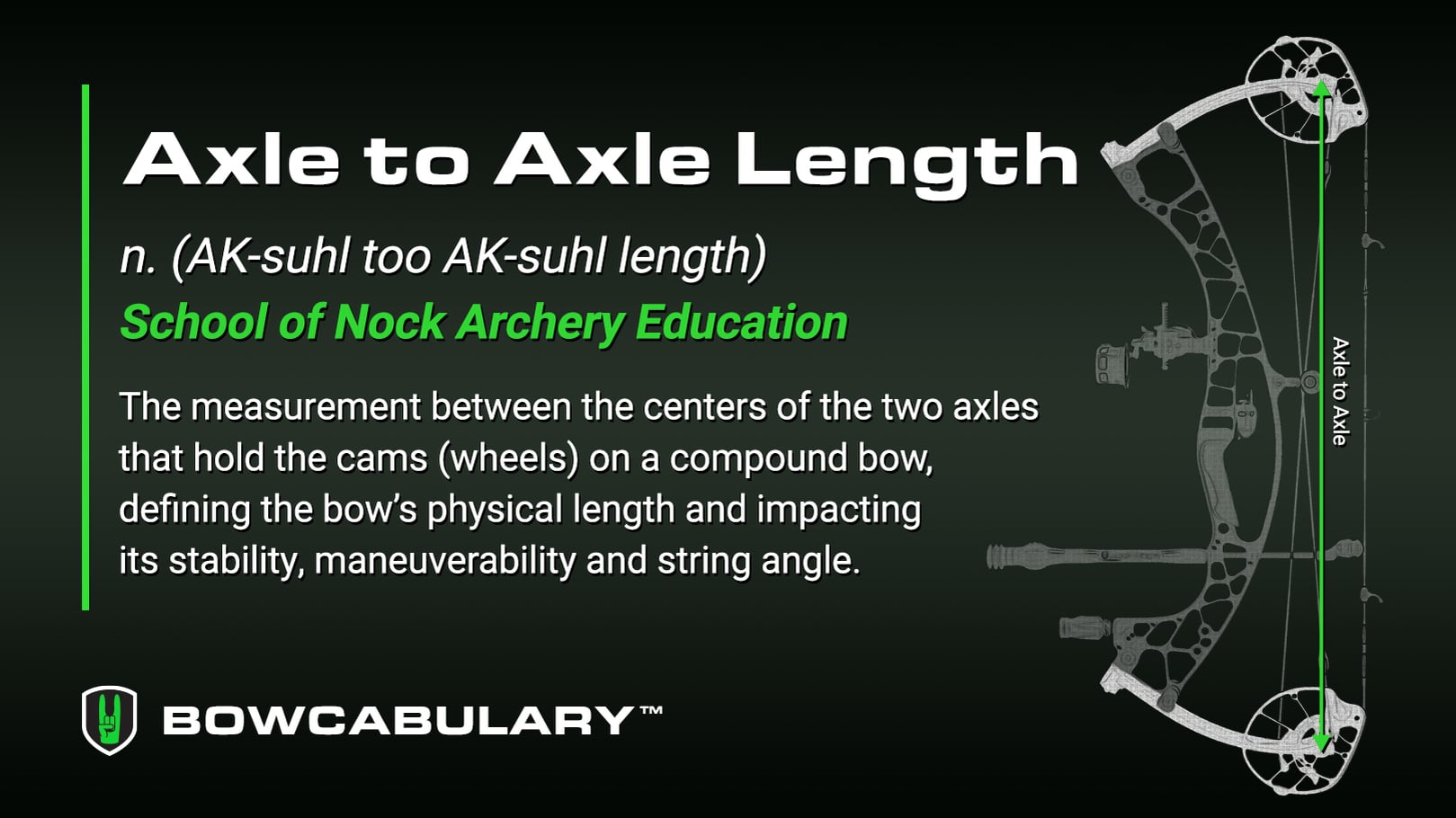
Axle-to-axle length (ATA) is one of the first specs you’ll see listed on any compound bow. It’s a simple measurement, but it affects each bow’s performance in ways most archers don’t fully appreciate.
ATA is the distance between the center points of the two axles that hold a compound bow’s cams (or wheels). That number defines the bow’s physical length and affects its stability, maneuverability, and string angle at full draw.
Why String Angle Matters
When you draw a compound bow back, the string creates a triangle between the two cams and your anchor point. The shorter the ATA, the sharper that triangle becomes. A sharper string angle pushes your peep sight further from your eye, and that distance changes how you aim.
Think of it like a BB gun with a rear sight and a front sight. Your peep sight is your rear sight on a bow. When the peep sits close to your eye, aligning it with the front sight (your pins) is quick and intuitive.
Now picture pushing that BB gun out to arm’s length and trying to line up both sights. That’s what a sharp string angle does to your aiming system.
The further your peep sits from your eye, the larger the peep aperture you’ll need to maintain a full sight picture. A larger peep lets in less precision. That’s the accuracy tradeoff with shorter ATA bows.
Short ATA Bows: Then vs. Now
Older short-ATA bows earned a bad reputation for a reason. Manufacturers paired short axle lengths with short brace heights, which means the string sat closer to the grip. That combination created a sharp string angle at full draw, making those bows difficult to shoot accurately.
Today’s short-ATA bows pair shorter axle lengths with taller brace heights and larger cam systems. The strings come off these larger cams farther from the axle centerlines, producing a wider string angle at full draw. You get the compact frame and tight-quarters maneuverability of a short bow with a string angle that’s far more forgiving than short bows were 15 years ago.
The Draw Length Factor
Here’s where ATA gets personal. Your draw length influences how sharp the string angle becomes on any bow. The longer your draw length, the sharper the angle.
A 27-inch draw archer shooting a 30-inch ATA bow will have a noticeably wider string angle than a 31-inch draw archer shooting the same bow. That’s why shorter-draw archers can often shoot compact bows with accuracy, even when the brace height runs on the shorter side.
Longer-draw archers feel every inch of ATA reduction more acutely, so the spec carries more weight in their bow selection process.
Maneuverability vs. Forgiveness
ATA creates a tradeoff between two priorities. A shorter ATA bow is easier to maneuver in a treestand, inside a ground blind, or when shooting from tight spots in thick cover. A longer ATA bow offers a more forgiving string angle and a steadier hold at full draw.
Neither choice is wrong. The right ATA depends on how you hunt and how your draw length interacts with the bow’s geometry:
- If you spend most of your season in a treestand surrounded by limbs, a compact setup might be worth the tradeoff.
- If you’re a long-draw archer who values pinpoint accuracy at distance, a longer ATA bow will work in your favor.
How to Measure ATA
Grab a tape measure and find the center of the top axle. Measure straight down to the center of the bottom axle. That number is your axle-to-axle length.
Most manufacturers list this spec on the bow, but it’s worth verifying with your own measurement, especially on a used bow.